
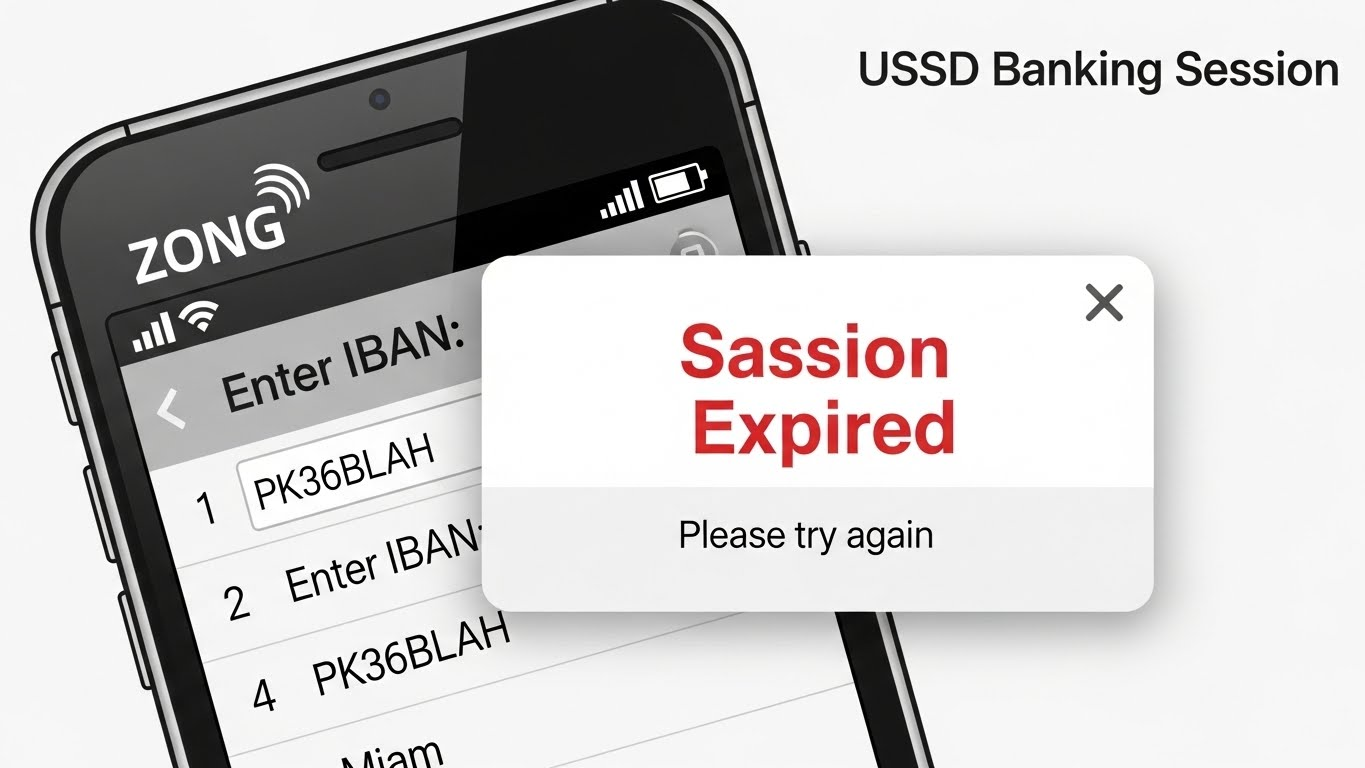
Introduction: When USSD Banking Becomes Impossible
USSD-based banking and account services are designed to help users who do not have smartphones or internet access. In theory, this makes USSD ideal for financial inclusion.
However, on the ZONG mobile network, many users report that USSD banking services fail repeatedly, even when they respond correctly and on time.
This article investigates why USSD banking fails specifically on ZONG, using technical behavior rather than assumptions or emotional accusations.
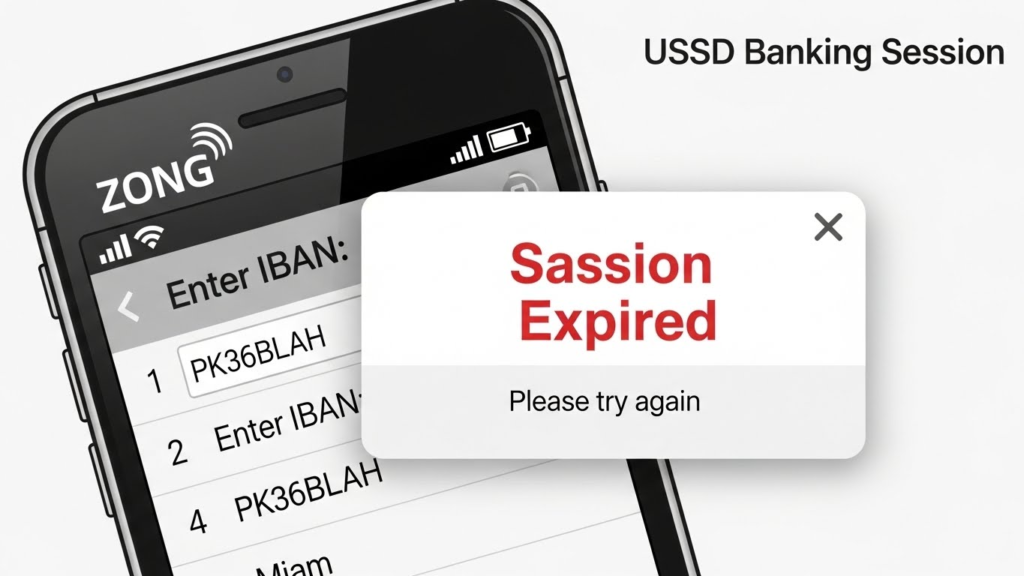
The Nature of USSD Banking on ZONG
USSD banking services on ZONG typically require:
- Step-by-step menu navigation
- Multiple confirmations
- Entry of long data such as:
- Account numbers
- IBANs
- CNIC numbers
These flows are sensitive to timing and session stability.
Unfortunately, ZONG’s USSD behavior shows clear signs of legacy session handling, which is not suitable for modern financial services.
Issue 1: Aggressive and Unstable Session Expiry
The most visible problem on ZONG is unexpected session expiry.
Users experience session termination:
- While reading instructions
- While typing long numbers
- Immediately after submitting valid input
This happens even when responses are given within reasonable time.
What This Indicates Technically
This behavior strongly suggests:
- Very short inactivity timeout values
- Low maximum session duration
- No tolerance for user thinking time
Such settings were common in early USSD implementations, but are not suitable for banking workflows.
Issue 2: Session Timer Is Not Properly Reset
In a well-designed USSD system:
Every valid user response refreshes the session timer.
On ZONG, evidence suggests that:
- User input is accepted
- Backend processing begins
- Session timer is not refreshed
- Session expires before the next menu appears
This creates a confusing experience where the user does everything correctly, yet the session still fails.
This is not a handset issue. It points to a USSD Gateway and backend synchronization problem.
Issue 3: Long Input Rejection During Financial Steps
USSD banking often requires users to enter long values such as IBANs or account numbers.
On ZONG:
- Long input increases the chance of session expiry
- Input is often rejected mid-entry
- The session collapses before confirmation
This indicates that ZONG’s USSD platform is not optimized for long input buffering, which is essential for financial services.
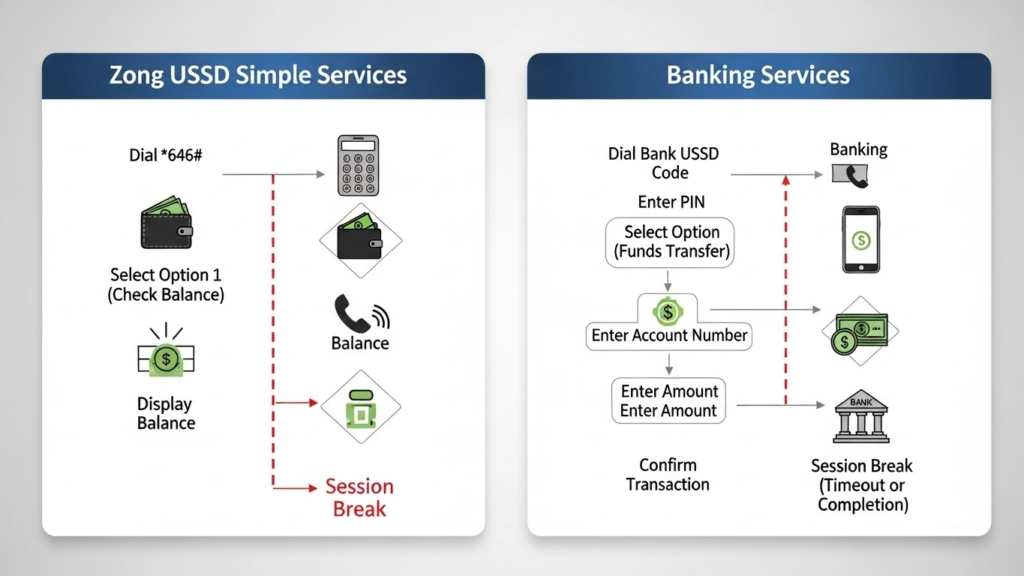
Why Simple USSD Services Still Work on ZONG
Despite these issues, ZONG’s USSD works well for:
- Balance checks
- Package activation
- Simple subscriptions
This is because these services:
- Require minimal input
- Finish within seconds
- Do not depend on multi-step logic
As a result, the deeper design flaw remains hidden.
Why Full USSD Codes Hide the Problem
Many experienced users dial full USSD paths, such as:
*XXX*1*2*ACCOUNT#
This approach:
- Sends all data in one request
- Avoids session navigation
- Bypasses timer reset issues
Because of this, users who rely on full codes often do not notice the underlying problem, while step-by-step users suffer.
Why Banking Services Expose ZONG’s USSD Weakness
Banking services expose weaknesses because they require:
| Requirement | ZONG USSD Behavior |
|---|---|
| Long sessions | ❌ |
| Input tolerance | ❌ |
| Timer refresh | ❌ |
| Multi-step stability | ❌ |
When these requirements are not met, failure becomes unavoidable.
The Impact on Financial Services
Because of these technical limitations:
- Users cannot complete transactions
- Trust in USSD banking decreases
- Support complaints increase
- Financial products struggle to survive
Several USSD-based payment and wallet services on ZONG have faced serious operational challenges as a result.
Why This Is a Design Problem, Not a User Problem
It is important to clarify:
- The issue is not user speed
- The issue is not handset quality
- The issue is not typing mistakes
The failure occurs inside the network, at the USSD session management level.
Conclusion
USSD banking fails on ZONG not because USSD is outdated, but because it is configured and treated as a legacy feature rather than a modern service platform.
Aggressive session expiry, failure to reset timers, and rejection of long inputs make USSD unsuitable for financial workflows in its current state.
Unless these architectural issues are addressed, USSD-based banking on ZONG will remain unreliable, regardless of how well the frontend menus are designed.