
Introduction: A Question Pakistan Still Asks
Is DTH available in Pakistan?
This question has echoed for more than two decades, yet the answer remains painfully simple: No.
Despite repeated planning, bidding rounds, investor interest, and even operational groundwork, Pakistan still does not have its own Direct-to-Home (DTH) satellite TV service. While neighboring countries moved forward, Pakistan remained stuck — not because of technology, but because of politics, pressure groups, illegal competition, and timing failures.
This is not a short failure.
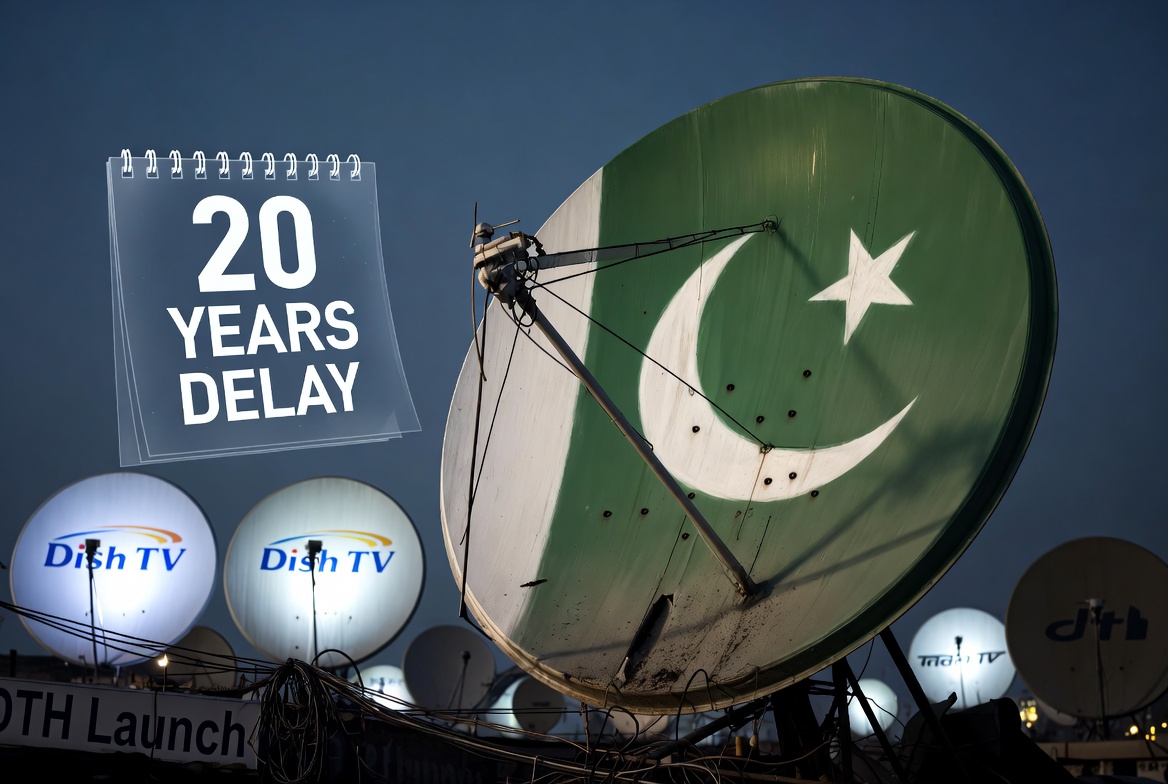
It is a 20-year delay story.
Pakistan Planned DTH — But Never Launched It
Pakistan’s DTH project was planned multiple times, formally discussed within PEMRA Pakistan, and even taken to the bidding stage.
👉 Three companies officially won DTH licenses through government bidding processes.
👉 Technical frameworks were approved.
👉 Satellite options like PAKSAT-1R were available.
Yet, not a single Pakistani DTH service ever reached the public.
Why?
The Biggest Irony: Indian DTH Worked Freely in Pakistan
While Pakistan debated legality and policy, Indian DTH services quietly dominated Pakistani rooftops.
Dish TV, Tata Sky, Airtel Digital TV — All Operated Illegally
For years, Indian DTH services were widely used across Pakistan:
- Dish TV
- Tata Sky
- Airtel Digital TV
- Videocon d2h
📡 These services were never legal, yet millions of dishes appeared on Pakistani homes.
Is Dish TV legal in Pakistan?
➡️ No, it never was.
But enforcement remained selective and inconsistent.
Border Tensions & Sudden Crackdowns
Whenever Pakistan-India border clashes occurred:
- Authorities launched operations against illegal DTH
- Dishes were removed
- Retailers were arrested
- Signals were jammed
But once tensions eased, enforcement softened again.
This on-off approach failed to protect local investors and destroyed confidence in launching a legal Pakistani DTH.
Dish TV’s Global Phase (2013–2016): A Pakistan-Centric Global Strategy
Between 2013 and 2016, Dish TV entered what can only be described as its most controversial and strategically aggressive phase — a phase that went far beyond India and quietly reshaped the satellite TV landscape in Pakistan and surrounding regions.
Officially, Dish TV remained an Indian DTH operator.
Unofficially, it was operating as a quasi-global DTH platform, stretching from the Middle East to South Asia, with Pakistan as its primary target market.
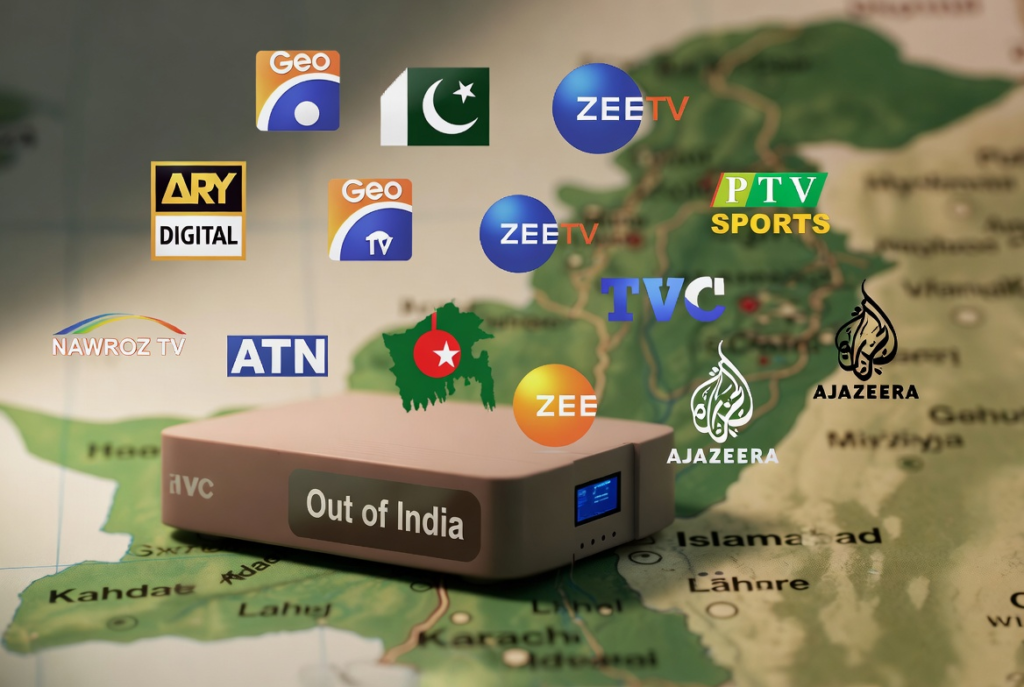
Not Just Indian Channels — A Multi-National Bouquet
During this period, Dish TV significantly expanded its channel lineup outside India, adding a wide range of:
- 🇵🇰 Pakistani TV channels
- 🇧🇩 Bangladeshi channels
- 🇱🇰 Sri Lankan channels
- 🇦🇫 Afghan channels
- 🌍 Select Middle Eastern channels
⚠️ These channels were NOT available on Dish TV boxes sold inside India.
They were exclusively activated on “out of India” Dish TV boxes, specifically configured for foreign markets.
And among all these regions, Pakistan received the highest priority.
Pakistan Was the Core Focus — Not Just One of Many Markets
Despite adding channels from multiple countries, Dish TV’s main strategic focus remained Pakistan.
- Maximum channel additions were Pakistani
- Almost all major and famous Pakistani TV channels were available
- News, entertainment, dramas, religious, and music channels were included
- The lineup closely resembled an unofficial Pakistani DTH channel list
In practical terms, Dish TV had created something Pakistan itself could not:
A fully functional “Pakistani DTH-like experience” — without being Pakistani, legal, or licensed.
This single factor further weakened the urgency for a local DTH launch, because:
- Viewers already had access
- Retail networks were already established
- Demand was being fulfilled illegally
A Structured Commercial Operation — Not Street-Level Piracy
This was not small-scale piracy or grey-market reselling.
Dish TV built a proper distribution and retail system in Pakistan:
- Authorized local dealers
- Regional distributors
- Customer support chains
- Installation networks
💵 Payments were collected in US Dollars, not PKR
💼 Transactions were made through:
- Telegraphic Transfers (TT)
- Demand Drafts
- Cross-border financial channels
This level of organization clearly indicated that Dish TV viewed Pakistan as a long-term commercial market, not a temporary experiment.
How This Hurt Pakistan’s Own DTH Dream
Dish TV’s Pakistan-focused expansion caused multiple long-term damages:
- Local investors stepped back
Why invest billions when an illegal alternative already dominates? - Regulators delayed decisions
Enforcement became reactive, not strategic. - Cable mafia felt protected
They used Indian DTH as an excuse to block Pakistani DTH. - Public demand pressure reduced
Because viewers were already “served”, even if illegally.
In simple words:
Dish TV filled the vacuum that Pakistan failed to fill — and by the time it collapsed, the window was already closing.
The Sudden Collapse After the Delhi High Court Case
This entire system came crashing down when a Gulf-based company won a legal case against Dish TV in the Delhi High Court.
As a result:
- Global transmissions were stopped
- “Out of India” boxes were disabled
- Pakistani channel feeds disappeared
- Retailers and distributors were abandoned overnight
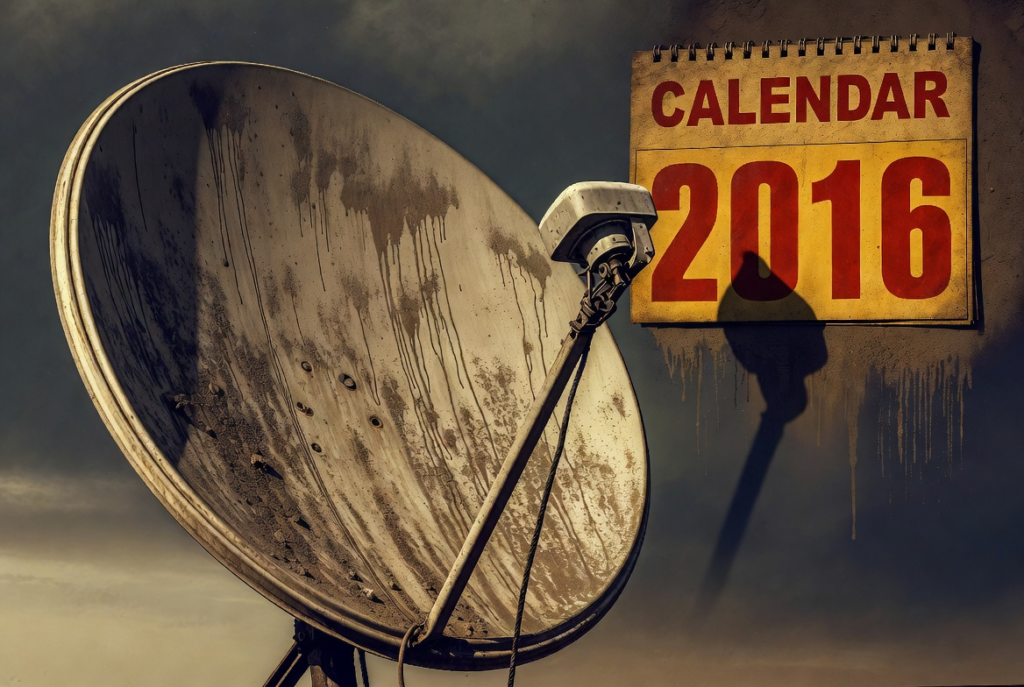
By 2016, Dish TV’s global phase had effectively ended.
But the damage was already done.
Why Dish TV Suddenly Stopped
Dish TV’s international operations collapsed after:
⚖️ A Gulf-based company won a legal case against Dish TV in the Delhi High Court
As a result:
- Global transmissions were halted
- Pakistani distribution networks collapsed overnight
- Retailers were left stranded
- Viewers lost access
By 2016, Dish TV’s unofficial era in Pakistan was effectively over.
The Hidden Blockers: Cable Mafia & PBA
Indian DTH was not the only obstacle.
Cable TV Mafia
Local cable operators saw DTH as an existential threat:
- DTH bypasses local cable networks
- No local control
- No forced bundling
- No regional monopoly
As a result:
- Cable groups lobbied heavily
- Applied pressure on regulators
- Spread fear among policymakers
Pakistan Broadcasters Association (PBA)
Major broadcasters also resisted:
- Fear of losing carriage power
- Advertising control concerns
- Revenue model disruption
Together, cable mafia + PBA formed a silent wall against Pakistani DTH.
Fake Assurance Operations Against Illegal DTH
To satisfy investors, authorities conducted:
- Periodic anti-DTH raids
- Public seizures
- Press releases
But these operations were temporary optics, not long-term solutions.
Investors asked a simple question:
“If illegal DTH keeps returning, how will legal DTH survive?”
No one had a convincing answer.
Pakistani DTH 2016: The Missed Moment
By 2016, Pakistan had:
- Available satellites
- Approved licenses
- Market demand
- Viewer frustration with cable quality
Yet the launch never happened.
That year became the last realistic window for Pakistani DTH.
The Internet Era Changed Everything
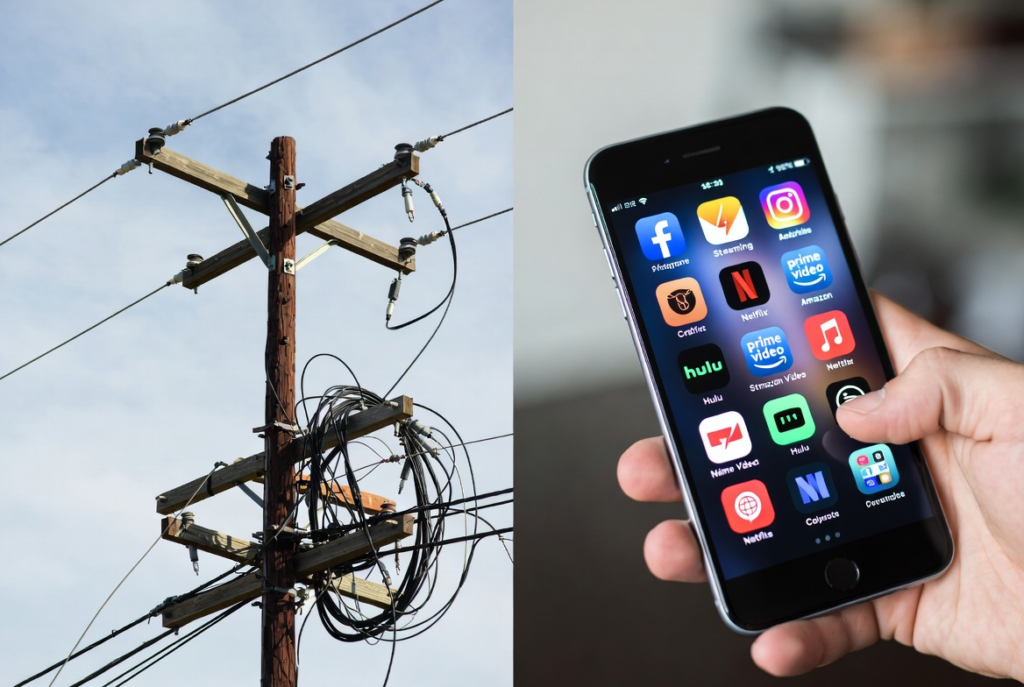
Today, the question has shifted.
📶 IPTV
📱 OTT platforms
🌐 YouTube
📡 Streaming apps
Is IPTV legal in Pakistan?
➡️ Yes — licensed IPTV is legal, illegal rebroadcasting is not.
Globally:
- DTH subscriptions are declining
- Operators are shutting down
- Internet-based TV dominates
So now the harsh reality:
Even if Pakistan launches DTH today, the market is already dying.
Common Public Questions — Answered Clearly
Is DTH available in Pakistan?
❌ No, not officially.
Is Dish TV legal in Pakistan?
❌ No, it was always illegal.
Which satellite is used for Pakistani channels?
📡 Mostly PAKSAT-1R and leased foreign satellites.
Does Pakistan have its own satellite?
✅ Yes — PAKSAT-1R
How many channels are on Paksat?
📺 Dozens, including:
- News
- Religious
- Regional
- Educational channels
Does Dish TV have Pakistani channels?
❌ No official Pakistani channels.
Does Sky have Pakistani channels?
❌ No.
Is there any free DTH in Pakistan?
⚠️ Only FTA satellite channels, not DTH.
Shahzad Sky DTH & Mag DTH — Rumors vs Reality
Names like:
- Shahzad Sky DTH
- Mag DTH
often circulate online.
🔍 Reality:
- No operational DTH
- No licensed service
- Mostly speculation or branding attempts
Pakistani DTH Channel List — A Dream That Never Materialized
Search terms like:
- Pakistani DTH channel list
- First Pakistani DTH service
- All TV channels list Pakistan
exist because people expected it to happen.
But history took another path.
Conclusion: A Project That Died Before Birth
Pakistan’s DTH did not fail because of technology.
It failed because of:
- Illegal foreign dominance
- Cable mafia pressure
- Broadcaster resistance
- Weak enforcement
- Poor timing
- And finally, the arrival of the internet era
Today, the question is no longer “Why hasn’t Pakistan launched DTH?”
The real question is:
Does it even make sense anymore?
