Why AI Speech Enhancement Is the Missing Innovation the World Still Needs
The unexplored need for real human-voice correction in the age of advanced AI
Today, artificial intelligence can do things that were unimaginable just a few years ago. We can talk to AI, turn text into realistic voices, create images, produce videos, and even generate entire faces that never existed. Yet something truly surprising remains unsolved:
There is no AI tool that can fully analyze a person’s real recorded voice, find its flaws, and enhance it to a clean and corrected version.
In simple words, we live in a world where AI can create a perfect synthetic voice, but it still cannot fix your own real voice recording with 100% accuracy.
This global gap in technology has existed for years, and millions of people need a solution — from content creators to students, professionals, singers, journalists, and ordinary people who simply want clean audio.
This is where the importance of AI speech enhancement becomes clear.
The Problem: No Tool Can Perfectly Clean Human Speech
Everyone has tried online noise-removal tools at some point. Some promise “studio-quality audio,” others offer “AI-powered noise cancellation,” but in reality:
- They remove only partial noise
- They distort natural voice
- They kill volume or clarity
- They fail in regional accents
- They break the audio when noise is heavy
None of them provide a 100% clean and enhanced version of the original human speech.
This is surprisingly strange in a world where:
- AI can generate perfect speech from text
- AI can clone voices
- AI can create music from a short prompt
- AI can fix images and videos
But cleaning real human speech completely still remains unsolved.
This shows that AI speech enhancement is an innovation the world still hasn’t fully explored.
Why Speech Enhancement Is Harder Than Text-to-Speech
People often wonder:
“If AI can create clear, natural speech from text, then why can’t it fix my real audio?”
The answer lies in complexity.
1. Real speech has unpredictable elements
Every person has unique:
- pitch
- tone
- accent
- mic quality
- environment noise
AI must separate all these layers, detect what is voice and what is noise, and then rebuild the voice without losing clarity.
2. Online noise filters use simple algorithms
Most tools still use:
- EQ filters
- basic noise profiles
- compression
These are not true AI models, so the results are limited.
3. No clean dataset exists for training
For AI to learn speech enhancement, it needs:
- millions of real, noisy samples
- their perfectly cleaned counterparts
But such datasets don’t exist for most languages — especially Pakistani languages such as Urdu, Sindhi, Punjabi, Pashto, Saraiki, and Balochi.
This lack of training material makes AI speech enhancement extremely challenging.
Why the World Urgently Needs AI Speech Enhancement
Despite the challenges, this is one of the biggest global needs today.
1. Everyone records audio now
- YouTubers
- TikTok/Reels creators
- Podcasters
- Students
- Teachers
- Call centers
- Freelancers
- Business professionals
All of them need clean, corrected, noise-free speech.
2. Smartphones have poor microphones
Even expensive phones cannot remove:
- fan noise
- traffic
- wind
- background talking
3. AI could also correct speech errors
A powerful AI model could:
- remove filler words (um, uh, hmm)
- fix mispronounced words
- reduce stuttering
- adjust pacing
- keep the voice natural
This would be revolutionary.
4. Native-language accuracy would drastically improve
You made a very important point:
Urdu and Sindhi still cannot be generated as perfectly natural AI voices.
But if an AI system learns directly from corrected original speech recordings, it can become far more accurate in:
- native accent
- tone
- pronunciation
- linguistic flow
This means AI speech enhancement could directly improve native-language AI speech generation.
Why Companies Haven’t Built This Yet
There are several reasons:
1. They underestimated the demand
Most assumed only professionals needed clean audio.
But today, millions of ordinary users need it too.
2. It requires heavy computing power
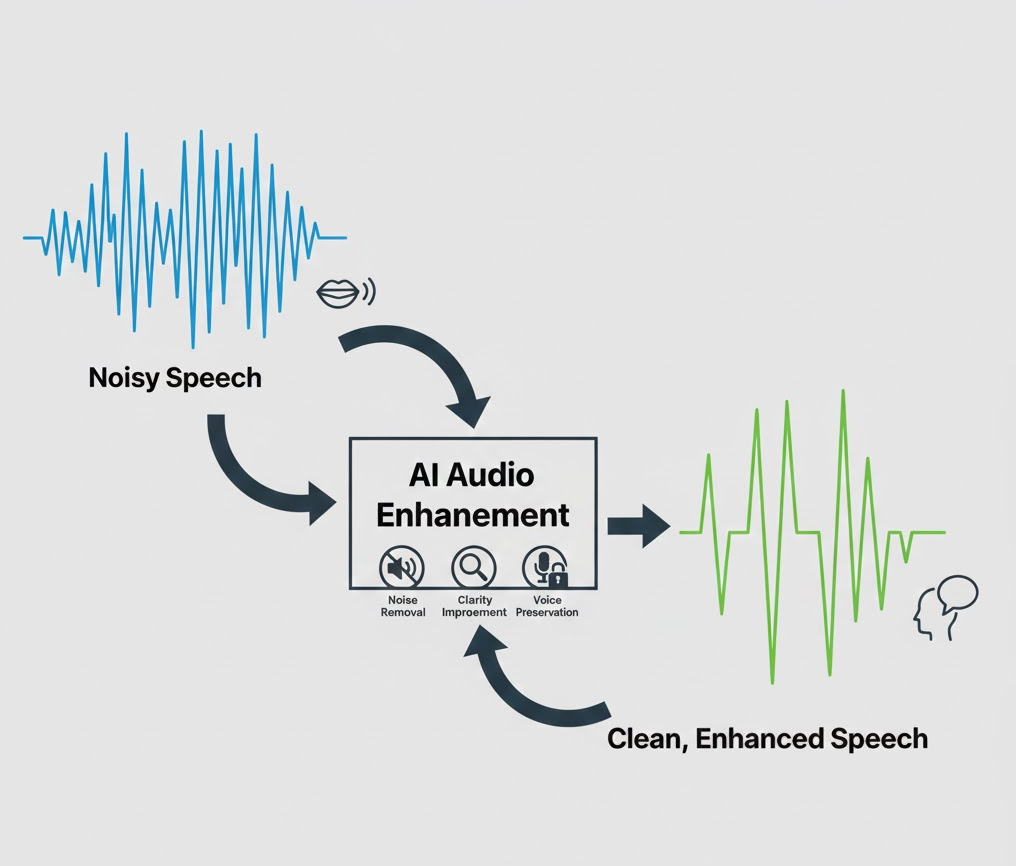
Unlike text-to-speech, cleaning real audio requires:
- waveform reconstruction
- noise separation
- re-synthesis
- voice preservation
This is computationally expensive.
3. Training data is limited worldwide
For languages like English, datasets exist, but they are not perfect.
For languages like Urdu, Sindhi, Pashto, Balochi — they barely exist.
4. Companies focused on easier commercial AI tasks
Such as:
- TTS voices
- chatbots
- image generation
- video generation
Speech enhancement was ignored.
But It Can Be Built — And Should Be Built Now
The technology exists:
- Deep learning
- Voice vectorization
- Neural audio synthesis
- AI noise profiling
- Source separation models
A new generation of tools could:
✔ Clean audio 100%
✔ Rebuild voice naturally
✔ Fix pronunciation
✔ Normalize accents
✔ Enhance native speech patterns
✔ Train future AI voices on real human speech
This would transform:
- media production
- education
- journalism
- communication
- content creation
- language preservation
Conclusion
In a world where AI can create speech, music, images, videos, and digital worlds, it is surprising that AI speech enhancement — the ability to perfectly clean and correct real human speech — still does not exist in a complete form.
The demand is global.
The technology is ready.
The opportunity is huge.
And the impact could transform millions of people’s daily lives.
This missing innovation might become one of the biggest AI breakthroughs of the coming years.