
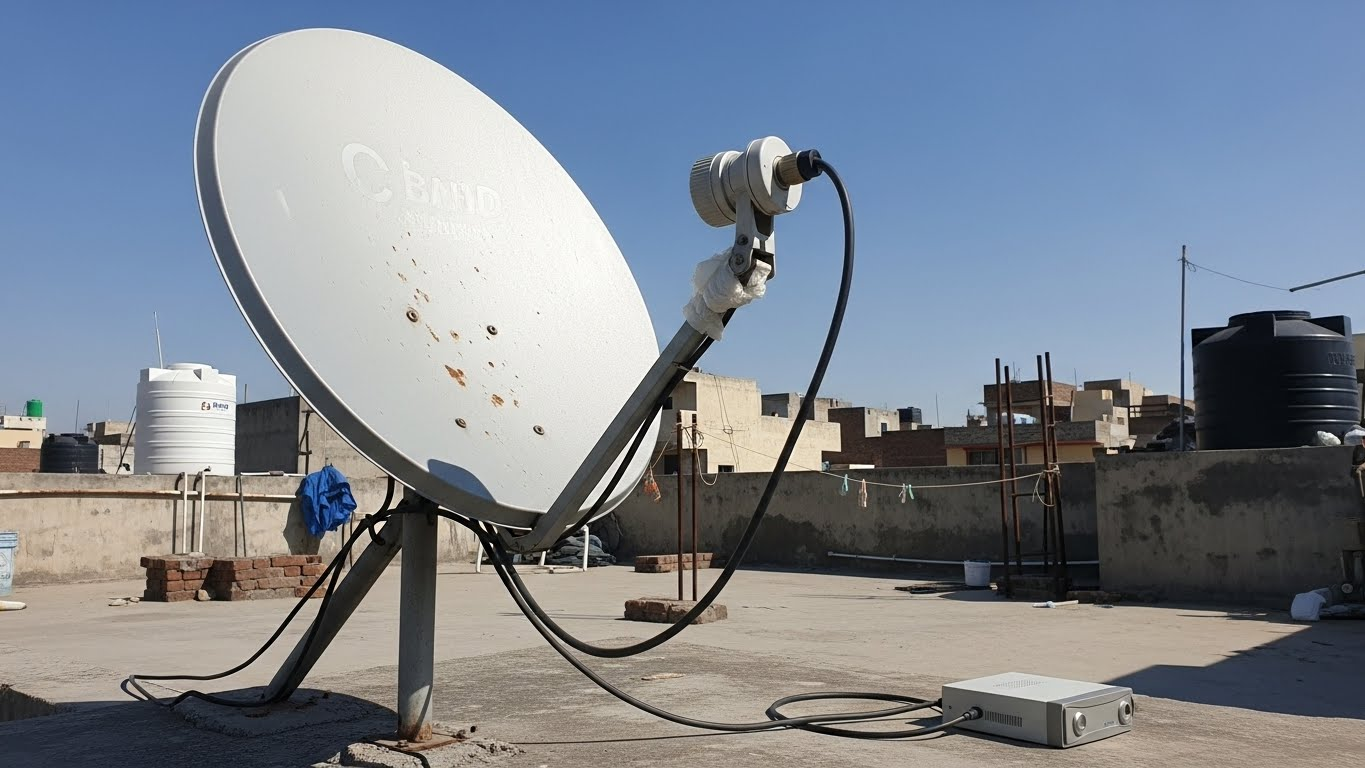
If you want crystal-clear free-to-air channels from Paksat satellites in Pakistan, understanding and setting up the LNB frequency 5150 MHz is crucial. This guide explains everything—from equipment and alignment to receiver configuration and troubleshooting—for Paksat-MM1 at 38.2°E, Pakistan’s modern C-band satellite.
Why Choose 5150 MHz for Your C-Band LNB? (Paksat LNB Frequency 5150)
- Standard for C-band: In Pakistan, 5150 MHz is the default Local Oscillator (LO) frequency for most C-band LNBs. It ensures compatibility with horizontal-polarization transponders on Paksat-MM1 and legacy Paksat-1R.
- OCS Support: For advanced multi-polarization setups, OCS LNBs (5150/5750 MHz) prevent signal loss on specific transponders.
- Receiver Compatibility: Works with most DVB-S2 receivers like StarTrack and Neosat. Avoid using Ku-band LNBs for C-band satellites.
Equipment Needed
- Satellite Dish: 4–6 ft (120–180 cm) C-band dish. Smaller dishes may work in cities like Lahore but require precise alignment.
- LNB: C-band LNB with 5150 MHz LO frequency (single, dual, or quad output). Price: PKR 500–1500.
- Receiver: DVB-S2 compatible receiver with blind scan (e.g., 1506G, GX6605S).
- Cables & Tools: RG6 coaxial cable, F-connectors, satellite finder meter/app, compass, inclinometer.
- Mount: Strong pole or wall mount with a clear southwest line-of-sight.
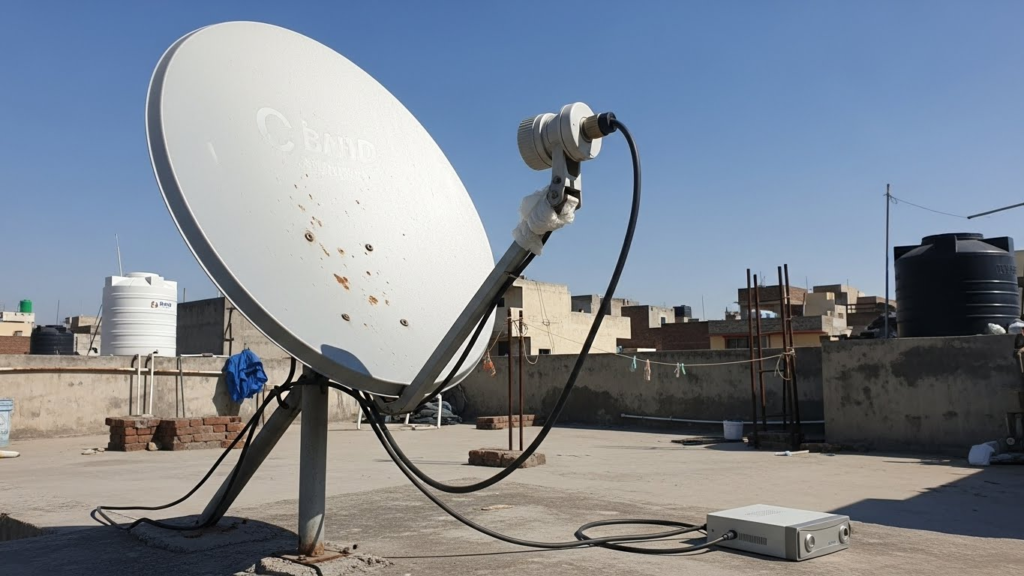
Step-by-Step Setup Guide
1. Site Selection & Dish Mounting
- Choose a location with an unobstructed view southwest (azimuth 120–140° depending on city).
- Mount the dish securely on a 1.5–2m pole. Use a plumb line for vertical alignment.
2. Dish Alignment (Azimuth, Elevation, Skew)
Use online calculators (satsig.net or sat-direction.com) to get precise values based on your location. Approximate values for Pakistani cities (2025):
| City | Azimuth | Elevation | LNB Skew (Anticlockwise) |
|---|---|---|---|
| Karachi | 122° | 60° | -20° |
| Lahore | 135° | 55° | -15° |
| Islamabad | 138° | 52° | -12° |
| Peshawar | 140° | 50° | -10° |
- Use a compass for azimuth, adjust elevation using dish scale, and rotate LNB for skew.
- Connect a satellite finder between LNB and receiver to maximize signal quality (aim 60–80%).
Tip: Align initially to a strong transponder like 3870 H 13333 (PTV Sports).
3. LNB Installation
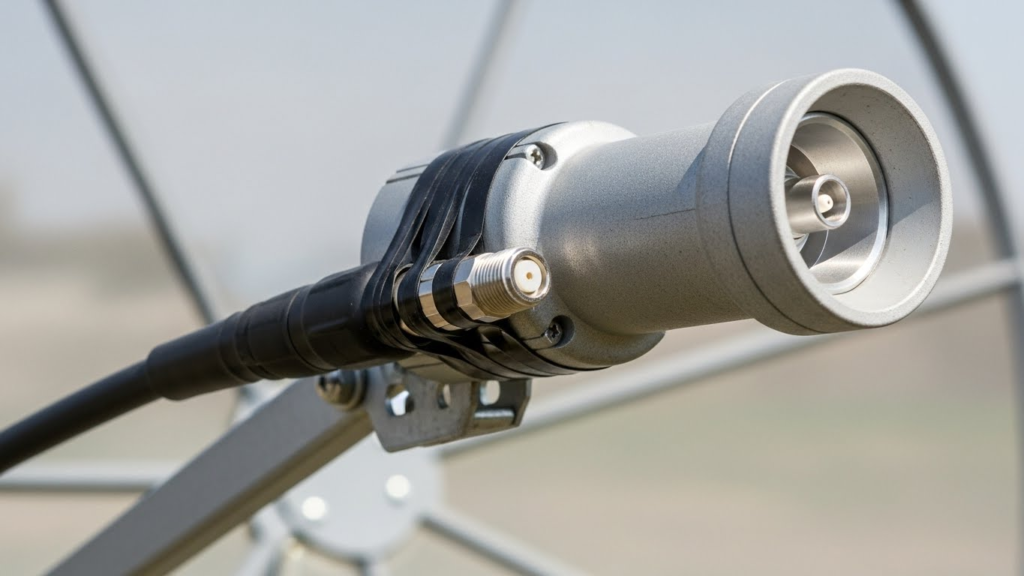
- Attach the LNB to the dish’s focal arm, set polarization to horizontal (H) for MM1.
- Connect RG6 cable to receiver, weatherproof connections with tape.
4. Receiver Configuration
- Power on receiver and TV. Navigate to Menu > Installation > Satellite Settings.
- Add Paksat MM1 at 38.2°E.
- Set LNB type: Standard/C-band, LO frequency: 5150 MHz, DiSEqC: Off, 22KHz: Off, Polarization: Auto/H.
- Add TP: 3870 H, SR 13333, FEC 3/4.
- Perform a blind scan or network scan to detect all channels.
5. Testing & Fine-Tuning
- Target 70–90% signal strength and 50–80% quality.
- Check popular FTA channels: PTV Sports (3870 H), Geo News (4086 H).
- Multi-satellite setups may require additional LNBs for Asiasat or Yahsat.
Common 2025 Transponders (Paksat-MM1, C-band, Horizontal)
| Frequency (MHz) | SR (kSym/s) | FEC | Example Channels |
|---|---|---|---|
| 3710 | 6400 | 3/4 | Apna, 8XM, Abb Takk |
| 3870 | 13333 | 3/4 | PTV Sports HD, PTV News |
| 3987 | 3600 | 3/5 | GTV News |
| 4086 | 16855 | 3/5 | Geo News HD (Conax) |
| 4099 | 3200 | 3/4 | LTN Family, Filmazia |
| 4125 | 6100 | 3/4 | Hum TV HD, Hum News |
Note: Always verify with LyngSat for updates.
Troubleshooting Common Issues
- No Signal: Recheck dish azimuth, elevation, and skew. Adjust slightly west if interference from 40°E satellites.
- Low Signal: Upgrade to 6ft dish or OCS LNB. Check cable quality; max 50m without amplifier.
- Frequency Mismatch: Some receivers need frequency adjustments for low TPs.
- Channels Not Scanning: Update firmware, use blind scan for 2025 transponder migrations.
- Weather Fade: C-band is resilient, but heavy rain may reduce signal—re-align if needed.
Safety Tip: Avoid mounting during high winds; ground the setup properly. With proper setup, this configuration should last through 2026 with minor tweaks.
Conclusion:
Setting up Paksat LNB 5150 for Paksat-MM1 ensures reliable access to C-band FTA channels across Pakistan. By following this step-by-step guide, using quality equipment, and fine-tuning alignment, you can enjoy uninterrupted viewing—even in challenging weather conditions.