
IKS vs IPTV Piracy: Why Satellite Card-Sharing Is Slowly Disappearing
From hacked smart cards to illegal streaming apps — how piracy quietly moved from satellite dishes to the internet
The End of an Era in TV Piracy
For nearly two decades, satellite card-sharing — especially Internet Key Sharing (IKS) — ruled the underground world of TV piracy. From rooftops filled with dishes to Linux-based receivers humming quietly in bedrooms, IKS gave millions access to premium TV channels without paying broadcasters.
But by 2025, something changed.
Forums went silent. Servers disappeared overnight. Old Dreambox users started asking a new question:
“Is IKS dead?”
The answer lies in a bigger shift — the explosive rise of IPTV piracy. While satellite card-sharing isn’t completely gone, it’s slowly being pushed into the shadows by faster, cheaper, and more flexible internet-based piracy.
This article explains why satellite card-sharing is disappearing, how IPTV replaced it, and what this shift tells us about the future of piracy itself.
What Was IKS? A Quick Refresher
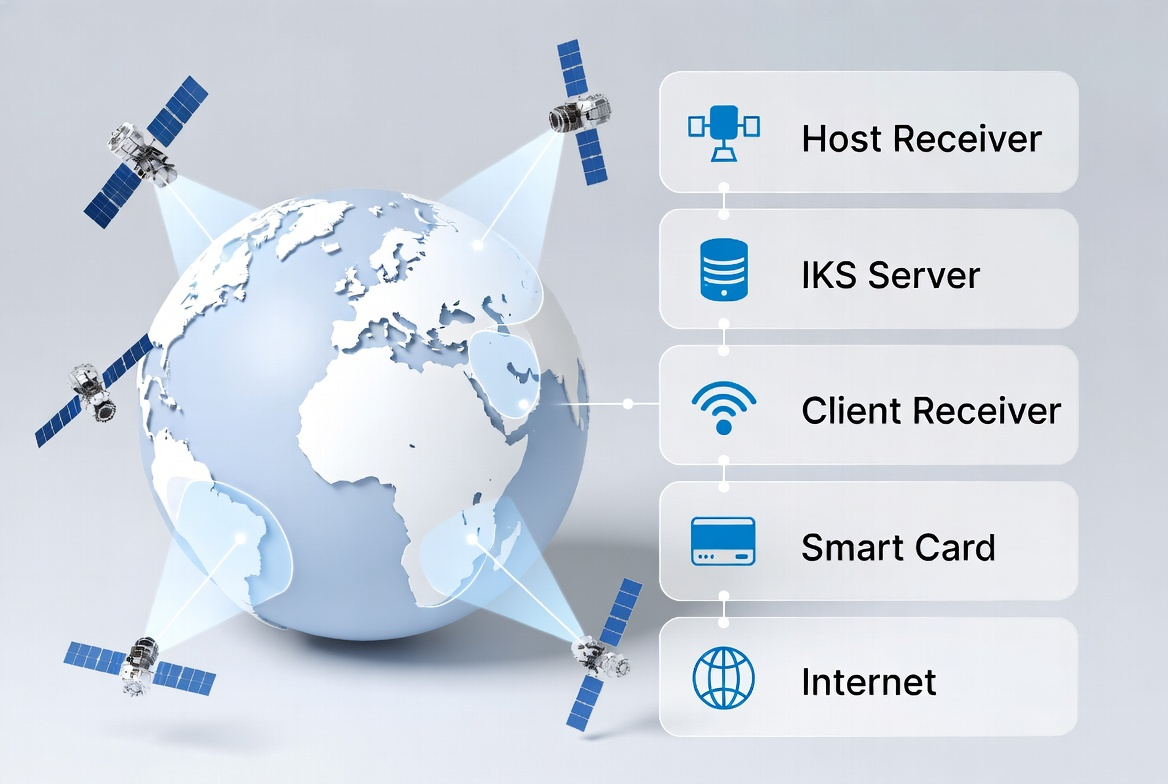
Internet Key Sharing (IKS) is a form of satellite TV piracy where decryption keys from a legitimate smart card are shared online in real time. Users connect their satellite receivers to IKS servers, allowing encrypted channels to open without an official subscription.
IKS rose after the decline of smart card cloning in the early 2000s and became extremely popular in:
- South Asia (India, Pakistan)
- Middle East & North Africa (MENA)
- Latin America
- Parts of Europe
It worked — but it was never simple.

Why IKS Once Dominated Piracy
IKS succeeded because it offered three powerful advantages at the time:
1. Cheap Access to Premium Content
Users paid as little as $8–$16 per year for access to expensive sports, movie, and international channels.
2. No Visible Downloads
Unlike torrents, IKS streamed content live, making users feel “safer” from copyright detection.
3. Better Than Early Internet
In regions with slow broadband, satellite signals were far more reliable than buffering streams.
For years, IKS felt unstoppable.
The Slow Collapse of Satellite Card-Sharing
Despite its popularity, IKS had a fatal weakness: it depended on satellite infrastructure.
1. Stronger Encryption & ECM Attacks
Broadcasters learned from early piracy disasters like DirecTV’s “Black Sunday” (2001). Over time, they introduced:
- Tamper-resistant smart cards
- Frequent encryption key changes
- Advanced Electronic Countermeasures (ECMs)
Each update broke IKS servers, forcing constant fixes. Many never recovered.
2. AI-Based Anti-Piracy Systems
By the 2020s, broadcasters shifted from reactive fixes to AI-driven detection, identifying abnormal key-sharing patterns and shutting down access faster than pirates could respond.
3. Hardware Dependence Became a Burden
IKS requires:
- Satellite dish alignment
- Specific receivers
- Firmware updates
- Internet + satellite sync
In a world moving toward mobile apps and smart TVs, this setup began to feel outdated.

Enter IPTV Piracy: The New King
While IKS struggled, IPTV piracy exploded.
Illegal IPTV services stream live TV and VOD content entirely over the internet, often offering:
- 1,000+ channels
- HD & Full HD quality
- Mobile, Smart TV, Firestick support
- No satellite dish required
For users, IPTV felt like magic.
Why Users Abandoned IKS for IPTV
1. Convenience Wins Every Time
IPTV works on:
- Smartphones
- Smart TVs
- Android boxes
- Laptops
No installation. No alignment. Just an app and login.
2. Better Stability (With Good Internet)
IKS suffered from:
- Weather disruptions
- ECM freezes
- Server outages
IPTV, while imperfect, offered on-demand playback, replays, and catch-up — features satellite piracy never mastered.
3. Social & Diaspora Demand
IPTV became especially popular among:
- NRIs
- Immigrant communities
- Expats seeking regional content
Ethnic channels, sports, and movies were easier to bundle via IPTV.

Legal Pressure: IKS Felt It First
Although both IKS and IPTV are illegal, IKS faced harsher early enforcement:
- Lawsuits targeting key-sharing servers
- Heavy fines for traffickers
- Easier IP tracing due to fixed server connections
- Hardware seizures
IPTV piracy, while also targeted, proved harder to eliminate due to:
- Constant domain changes
- Cloud hosting
- Encrypted streaming paths
This imbalance accelerated IKS decline.
Comparison: IKS vs IPTV Piracy (2025)
| Feature | IKS / Card-Sharing | IPTV Piracy |
|---|---|---|
| Infrastructure | Satellite + Internet | Internet only |
| Hardware | Dish + Receiver | Any smart device |
| Reliability | ECM-prone | Depends on internet |
| Popularity (2025) | Declining | Rapidly growing |
| Legal Risk | High & traceable | High but decentralized |
Is Satellite Card-Sharing Completely Dead?
Not entirely.
IKS still exists in:
- Legacy communities
- Rural areas with poor broadband
- Closed private networks
But its golden age is over.
Just like smart card cloning vanished, IKS is becoming a niche relic — remembered more than used.
Final Thoughts: Piracy Didn’t End — It Adapted
The fall of satellite card-sharing isn’t a victory over piracy — it’s a shift in form.
Piracy always follows:
- Technology
- Convenience
- Price gaps
As long as legal TV remains expensive or inaccessible, new piracy models will emerge. But one thing is clear:
The future of piracy is online, not in the sky.
For users, the risks — malware, scams, legal trouble — now outweigh the savings. And for broadcasters, the real battlefield is no longer satellites, but the internet itself.