
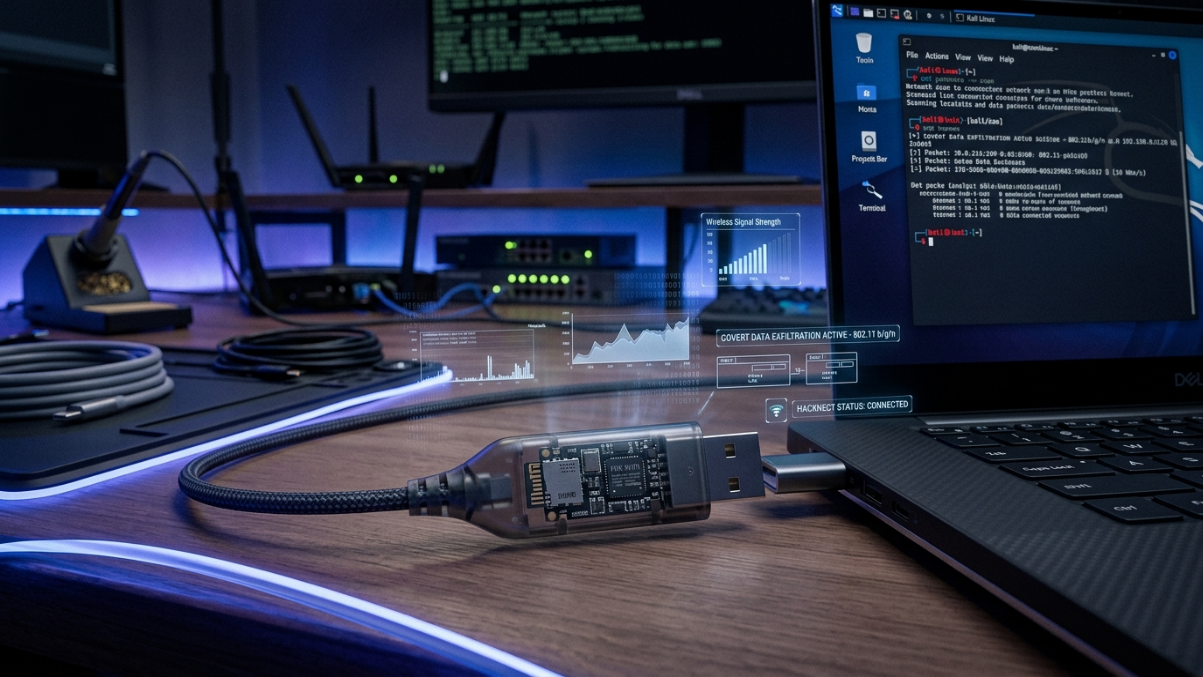
The Hacknect USB Cable is an advanced covert hardware platform designed for wireless automation, cybersecurity learning, and penetration testing. At first glance, it appears to be a completely ordinary USB cable. However, hidden inside its connector shell is a powerful microcontroller, wireless networking hardware, and expandable storage capabilities.
Developed by Nick Bild and introduced through a crowdfunding campaign, the Hacknect USB Cable has quickly attracted attention from cybersecurity professionals, ethical hackers, penetration testers, and hardware enthusiasts. Its stealthy design and powerful functionality make it one of the most interesting hardware security tools currently emerging in the cybersecurity landscape.
What Is the Hacknect USB Cable?
The Hacknect USB Cable is essentially a miniature embedded computer disguised as a regular USB cable. Unlike standard charging or data cables, it contains a fully functional wireless-enabled microcontroller capable of executing automated tasks, interacting with connected devices, and performing penetration testing operations.
Its design resembles older covert hacking tools such as the O.MG Cable, but the Hacknect USB Cable expands beyond offensive security use cases by supporting wireless automation, maker projects, remote control applications, and data logging.
Because the hardware is fully concealed inside the USB connector, the cable looks almost identical to a standard USB accessory, making it extremely difficult to identify through visual inspection alone.
Core Hardware Specifications of the Hacknect USB Cable
The Hacknect USB Cable packs an impressive amount of hardware into a compact connector housing.
Wi-Fi Enabled Microcontroller
At the heart of the Hacknect USB Cable is a wireless microcontroller, typically based on ESP32-class hardware or similar low-profile chipsets. This onboard MCU enables the cable to:
- Create its own Wi-Fi access point
- Connect to existing wireless networks
- Receive remote commands wirelessly
- Execute automated scripts and payloads
This wireless functionality allows operators to control the cable remotely using a smartphone, laptop, or tablet.
Hidden microSD Card Storage
Another major feature of the Hacknect USB Cable is its concealed microSD card slot. This hidden storage capability allows the device to:
- Store payloads and scripts
- Log captured data
- Save automation tasks
- Operate independently from the host machine
Because the data is stored internally, the cable can continue functioning even when the connected computer has limited storage permissions.
Stealth USB Form Factor
One of the most notable aspects of the Hacknect USB Cable is its covert design. The entire hardware platform fits directly inside a standard USB-A or USB-C connector shell.
When connected to a computer, wall charger, or power bank, the cable behaves and appears like a normal charging cable. This stealth factor is what makes covert USB implants particularly concerning from a cybersecurity perspective.
Capabilities of the Hacknect USB Cable
The Hacknect USB Cable supports a wide range of cybersecurity and automation functions thanks to its ability to interact directly with USB data lines.
Keystroke Injection and BadUSB Functionality
For ethical hackers and penetration testers, the Hacknect USB Cable can operate similarly to a Rubber Ducky or BadUSB implant.
Once connected to a target system, the cable can impersonate a USB keyboard using the HID (Human Interface Device) class. This enables it to automatically inject:
- Terminal commands
- PowerShell scripts
- Keyboard shortcuts
- Automated text input
- Remote payload execution
Because typing speeds are extremely fast, automated command execution can happen within seconds.
Remote Wireless Payload Triggering
Unlike traditional USB attack devices that require preloaded payloads, the Hacknect USB Cable includes built-in Wi-Fi connectivity for real-time remote control.
An operator can connect to the cable wirelessly from another room or nearby location and trigger specific commands dynamically. This significantly increases flexibility during penetration testing scenarios and cybersecurity demonstrations.
Wireless Automation and Maker Applications
The Hacknect USB Cable is not limited to offensive security research. Its creator also positions it as a flexible automation platform for developers and makers.
Potential applications include:
- Remote control of USB-connected hardware
- Wireless automation workflows
- Embedded device communication
- IoT experimentation
- Legacy hardware integration
This broader functionality distinguishes the Hacknect USB Cable from many single-purpose penetration testing tools.
Background Data Logging
Another important capability is background data logging. The cable can monitor or stream information from connected peripherals and either:
- Broadcast the data over Wi-Fi
- Save it locally to the microSD card
This allows continuous monitoring without relying on the host system for storage or connectivity.
Security Risks Associated With the Hacknect USB Cable
The emergence of devices like the Hacknect USB Cable highlights a critical cybersecurity principle:
Physical access often equals total access.
Because covert USB implants can visually mimic ordinary accessories, they pose a serious risk in enterprise environments, public spaces, and shared workplaces.
Potential threats include:
- Unauthorized keystroke injection
- Malware deployment
- Credential theft
- Data exfiltration
- Remote system manipulation
- Hidden data collection
Organizations that rely heavily on USB peripherals may face increased exposure if proper device security policies are not implemented.
How to Protect Against Covert USB Implants
Security professionals use several defensive strategies to reduce the risk posed by hidden hardware implants like the Hacknect USB Cable.
Endpoint Detection and Response (EDR)
Modern EDR solutions can identify suspicious USB behavior. For example, if a charging cable suddenly registers itself as a keyboard device and begins typing commands automatically, advanced security software may block or quarantine the device.
Behavioral anomaly detection plays a critical role in preventing USB-based attacks.
USB Device Restrictions
Many organizations disable unauthorized USB devices through operating system policies or endpoint management systems.
These restrictions can block:
- Unapproved HID devices
- Unknown USB storage devices
- External peripherals
- Unauthorized data transfers
USB whitelisting policies are especially common in highly secure corporate networks.
USB Data Blockers
For public charging stations in airports, hotels, and cafes, many users rely on USB data blockers, commonly known as “USB condoms.”
These adapters allow electrical power to pass through while physically disconnecting the USB data pins. As a result, hidden microcontrollers cannot communicate with connected devices.
This provides protection against both data theft and malicious USB payload execution.
The Growing Importance of Hardware Security
The Hacknect USB Cable demonstrates how compact embedded hardware continues evolving in both cybersecurity and maker communities. While such tools can be valuable for ethical hacking, penetration testing, and wireless automation research, they also reinforce the importance of physical device security.
As covert USB implants become more sophisticated, organizations and individual users must adopt stronger USB security practices, endpoint monitoring, and device access controls.
Understanding how tools like the Hacknect USB Cable operate is an essential step toward improving cybersecurity awareness and defending against modern hardware-based threats.
Conclusion
The Hacknect USB Cable combines stealth hardware design, wireless connectivity, embedded storage, and USB-based automation into a compact covert platform. Its capabilities range from penetration testing and keystroke injection to wireless maker automation and background data logging.
Although it serves legitimate cybersecurity research and automation purposes, the device also highlights the growing risks associated with hidden USB implants and physical access attacks.
As cybersecurity threats continue evolving, awareness, endpoint protection, and strict USB security policies remain essential defenses against covert hardware platforms like the Hacknect USB Cable.