
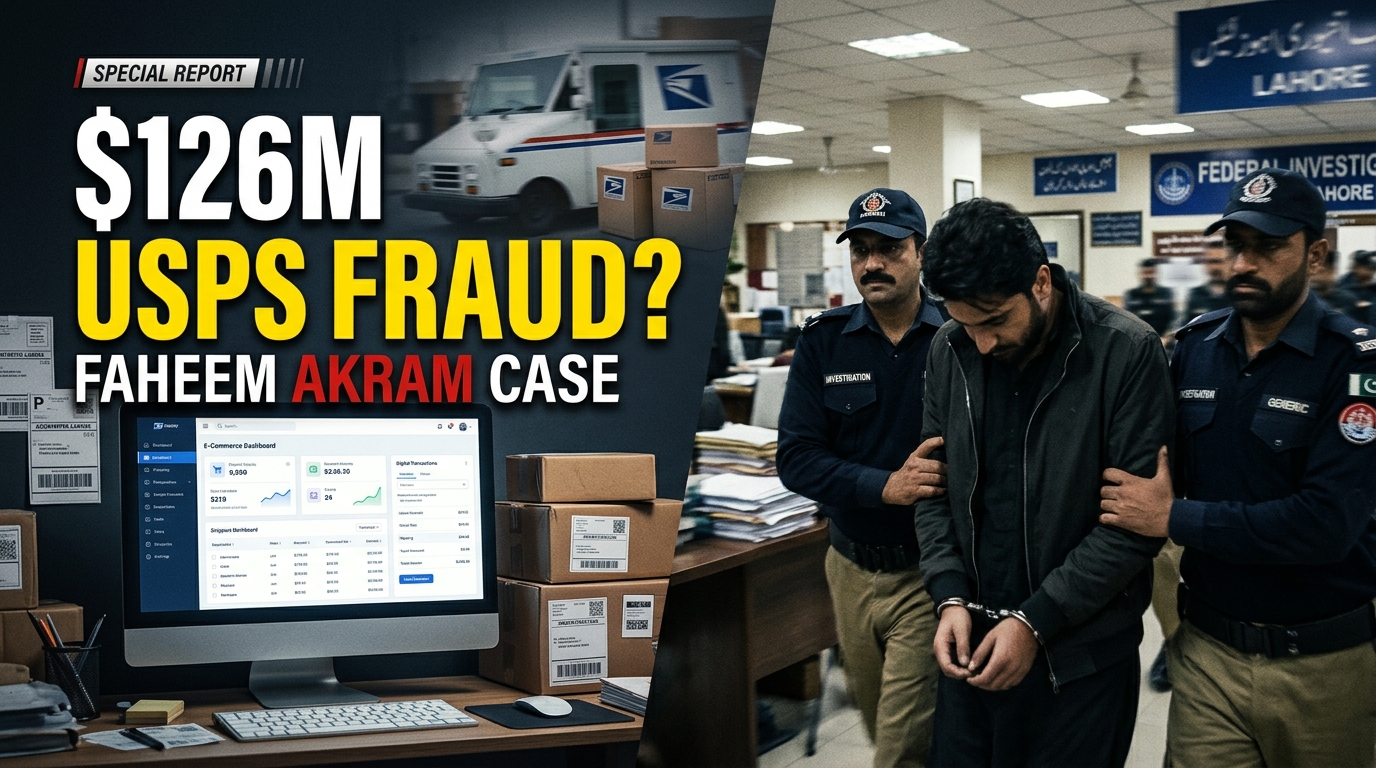
Faheem Akram case: Pakistani authorities arrested 33-year-old Faheem Akram in Lahore on October 20, 2026, following allegations that he operated LabelsBank.com, an unauthorized website that allegedly sold more than 5.1 million counterfeit United States Postal Service (USPS) shipping labels. According to the U.S. Department of Justice (DOJ), the alleged scheme caused more than $126 million in losses to the American postal service. Pakistani investigators have separately estimated the value of the transactions at approximately Rs 35 billion.
The case attracted international attention after a federal grand jury in Florida indicted Akram in September 2026. The U.S. Postal Inspection Service (USPIS) subsequently announced a reward of up to $100,000 for information leading to his arrest and conviction. His arrest in Pakistan was followed by a series of court proceedings and an investigation into financial transactions, digital records and individuals allegedly connected to the operation.
As of October 27, 2026, the case remains an evolving legal matter. The allegations have not, by themselves, established guilt, and the distinction between the alleged losses suffered by USPS and the website’s actual revenue is essential to understanding the case.
Quick Facts About the Faheem Akram Case
| Detail | Information |
|---|---|
| Name | Faheem Akram, also reported as Fahim Akram |
| Age | 33, according to U.S. authorities |
| Nationality | Pakistani |
| Reported hometown | Khanewal, Punjab, Pakistan |
| Website | LabelsBank.com |
| Nature of allegations | Sale of counterfeit U.S. postage and shipping labels |
| Alleged operating period | August 2023 to September 2026 |
| Counterfeit labels | More than 5.1 million |
| Reported customers | More than 5,200 |
| Typical advertised price | Approximately $2 per label |
| Alleged USPS losses | More than $126 million |
| Estimated transaction value in Pakistan | Approximately Rs 35 billion |
| U.S. indictment announced | September 28, 2026 |
| Arrest in Pakistan | October 20, 2026, in Lahore |
| Pakistani investigating agency | National Cyber Crime Investigation Agency (NCCIA) |
| U.S. reward | Up to $100,000 |
| Latest reported remand update | Four additional days on October 26, until October 30 |
| Current legal status | Proceedings and investigations ongoing as of October 27, 2026 |
The principal figures concerning the American allegations come from the official U.S. Department of Justice announcement. Pakistani investigation details have also been reported by Dawn and other news organizations.
1. Who Is Faheem Akram?
Faheem Akram is a Pakistani national from Khanewal, a city in Punjab province. U.S. prosecutors identified him as 33 years old in their September 28, 2026, indictment announcement.
The investigation centres on his alleged operation of LabelsBank.com, a website that reportedly offered U.S. postage and shipping labels at unusually low, fixed prices.
According to American prosecutors, the website was not authorized to sell USPS postage products and services. The labels allegedly enabled customers to ship packages at prices substantially below legitimate postal rates.
Pakistani authorities subsequently arrested Akram in Lahore and began investigating the alleged operation, its financial channels and the people who might have been involved.
What is known about his education and personal background?
Some local reports have described Akram as having a software engineering education. However, the publicly available official information cited in connection with the American indictment does not establish his educational qualifications in sufficient detail.
Likewise, his reported residence in Khanewal is supported by official and media accounts, but a comprehensive, independently verified biography has not emerged.
There is also no clearly established public record demonstrating that he previously maintained a prominent social media presence. The absence of an identified public profile, however, does not prove that he never used social media.
For these reasons, claims about his education, professional career before LabelsBank.com or personal motivations should be treated cautiously.
2. What Was LabelsBank.com Allegedly Doing?
LabelsBank.com is at the centre of the American criminal allegations. According to the DOJ, the website allegedly sold counterfeit U.S. postage labels between August 2023 and September 2026.
The pricing model was one of the most significant features of the alleged operation.
Customers reportedly paid approximately $2 per label, regardless of the parcel’s weight, size or destination. Legitimate shipping prices, by contrast, depend on the applicable postal service, package characteristics, destination and other pricing conditions.
According to prosecutors, the allegedly counterfeit labels allowed customers to send packages without paying the full legitimate postage charges.
The American investigation identified more than 5,200 customers who allegedly purchased over 5.1 million labels through the website.
These figures suggest a substantial online operation. Nevertheless, the number of customers does not establish that every buyer knowingly participated in fraud. The available public information also does not establish that every person who purchased a label has been charged with a crime.
How could counterfeit postage create such large losses?
Postal services depend on valid postage payments to cover the costs associated with transporting and delivering mail and packages.
When counterfeit labels are accepted or used to move parcels without the appropriate postage payment, the postal service may lose revenue and incur shipping costs that have not been properly covered.
In the LabelsBank.com case, U.S. prosecutors allege that the website’s business model enabled customers to obtain postage far below legitimate rates, producing substantial financial losses for USPS.
The exact technical method used to create the alleged counterfeit labels, the systems involved and the complete evidentiary details should not be assumed beyond what investigators and court records establish.
Why was the website important to the investigation?
An online platform can leave several types of evidence, including:
- Website registration and domain records.
- Customer and transaction records.
- Payment information and financial transfers.
- Digital communications and account activity.
- Shipping-label records and related postal data.
These are potential categories of evidence in an online fraud investigation, not a verified inventory of every item seized or recovered in this particular case.
The publicly announced U.S. investigation resulted in a court-authorized seizure and shutdown of LabelsBank.com and the associated domain.
3. The $126 Million Figure: Losses, Not Proven Personal Income
One of the most important aspects of the Faheem Akram case is the distinction between the alleged financial damage and the money the website may have received.
According to the DOJ, the alleged counterfeit-postage operation caused more than $126 million in losses to USPS.
That figure represents the alleged loss to the postal service, including lost revenue and shipping costs. It is not an official estimate of Faheem Akram’s personal wealth or income.
The distinction matters because the website reportedly sold labels for approximately $2 each, while the alleged postal losses arose from the much larger value of legitimate postage and associated shipping costs that prosecutors say were avoided.
The Pakistani investigation has separately placed the transaction value at approximately Rs 35 billion.
These figures describe different financial concepts and should not automatically be treated as interchangeable.
What remains unknown?
As of October 27, 2026, the publicly available information discussed in this report does not establish:
- The exact net profit earned by the website.
- The precise amount personally received by Akram.
- The total amount of money recovered or frozen by authorities.
- Whether every transaction identified by investigators has been fully traced.
- The final financial liability, if any, that a court may establish.
Until financial records and judicial findings clarify these questions, claims that Akram personally earned $126 million would be misleading.
4. U.S. Federal Indictment and Criminal Charges
On September 28, 2026, the U.S. Attorney’s Office for the Southern District of Florida announced that a federal grand jury had indicted Faheem Akram over the alleged counterfeit-postage operation.
The announcement identified three categories of charges.
Charge 1: Conspiracy to Defraud the United States
The indictment includes one count alleging a conspiracy to defraud the United States and to make and sell counterfeit postage stamps.
This charge concerns the alleged agreement and conduct described by prosecutors. Its ultimate legal significance depends on the evidence presented and the applicable law.
Charges 2–6: Making and Selling Counterfeit Postage Labels
The indictment includes five counts relating to the alleged making and selling of counterfeit postage stamp labels.
These charges concern the alleged production and sale of unauthorized postage labels through the operation under investigation.
Charges 7–10: Wire Fraud
The indictment also includes four counts of wire fraud.
Wire fraud charges generally concern the alleged use of electronic communications or interstate or international communications systems in connection with a fraudulent scheme. The specific elements and evidence applicable to each count must be assessed through the legal proceedings.
What penalties could apply if convicted?
According to the DOJ announcement, the maximum penalties include:
| Category of charge | Maximum stated penalty |
|---|---|
| Conspiracy count | Up to five years in prison |
| Counterfeit-postage counts | Up to five years in prison |
| Each wire fraud count | Up to 20 years in prison |
These are statutory maximums cited by prosecutors, not a prediction of the sentence Akram would receive.
Any actual sentence would depend on the convictions, applicable law, sentencing rules and the circumstances established in court.
The DOJ has explicitly stated that an indictment is an allegation and that defendants are presumed innocent unless proven guilty beyond a reasonable doubt.
Official source: U.S. Department of Justice, Southern District of Florida.
5. Why Did the United States Offer a $100,000 Reward?
Following the indictment, the U.S. Postal Inspection Service published a wanted notice concerning Faheem Akram and announced a reward of up to $100,000.
The reward is offered for information leading to his arrest and conviction. It is not a payment automatically due to anyone who provides information, nor does the announcement itself establish guilt.
The official notice identifies the matter under reference number 4572266.
According to the USPIS notice, individuals with relevant information can contact the agency at 1-877-876-2455 and say “Law Enforcement.”
The agency also warns members of the public not to attempt to apprehend the wanted person themselves.
The reward announcement demonstrates the seriousness with which U.S. authorities were pursuing the case before Akram’s arrest in Pakistan. However, it does not independently establish what evidence was decisive in identifying or locating him.
The official wanted notice is available through the U.S. Postal Inspection Service.
6. How Was Faheem Akram Traced and Arrested in Pakistan?
The National Cyber Crime Investigation Agency carried out the Pakistani investigation that led to Akram’s arrest in Lahore on October 20, 2026.
According to details attributed to NCCIA Lahore Zone Additional Director Atif Ameer and reported by Pakistani media, investigators conducted a specialized locator operation lasting approximately 10 days.
The operation reportedly involved teams working across Punjab, Islamabad and Sindh.
Reported investigation figures
The following figures were reported in connection with the operation:
| Investigative activity | Reported figure |
|---|---|
| Specialized locator operation | 10 days |
| Special investigation teams | 8 |
| Locations raided | 35 |
| Individuals questioned | 47 |
| Call detail records analysed | 122 |
| IMEI tracking reports analysed | 50 |
| Camera recordings subjected to analysis | 120 |
These figures describe the investigation as reported by Pakistani authorities and the media. They should not be interpreted as independently audited findings.
How did digital and forensic techniques assist?
Investigators reportedly examined call detail records, device-related information and audio or video recordings as part of their efforts to trace Akram’s movements and identify possible connections.
Call detail records can help establish patterns of communication. IMEI-related information can assist with identifying or tracing mobile devices, subject to the available records and applicable legal procedures. Camera footage may help investigators establish a person’s movements or presence at particular locations.
The reported use of artificial intelligence and other advanced technology in analysing camera recordings does not, by itself, demonstrate that AI identified Akram or was the decisive factor in his arrest.
The public information available does not establish the precise contribution of each investigative technique or disclose the complete operational sequence.
Some reports have suggested that information was shared by the FBI. However, without a sufficiently detailed official confirmation, the specific nature and role of any FBI assistance should be treated as unconfirmed.
Who supervised the investigation?
Media reports identified NCCIA Lahore Zone Additional Director Atif Ameer as the official who presented details of the case.
The reported joint investigation team included Deputy Directors Waqas Saeed and Hassan, SHO Najam Bajwa, and Sub-Inspectors Nabeel and Tanveer.
The complete official case file, internal investigative reports and detailed statements from the team have not been made publicly available in the material cited here.
7. The 16 Bank Accounts Under Investigation
One of the major areas of the Pakistani investigation concerns financial transactions allegedly associated with LabelsBank.com.
According to NCCIA officials, investigators identified 16 bank accounts reportedly used in connection with the alleged operation.
The reported distribution was:
| Reported account holder | Number of accounts |
|---|---|
| Faheem Akram | 7 |
| His brother | 5 |
| His wife | 2 |
| His sister | 1 |
| His aunt | 1 |
| Total | 16 |
These figures were reported by Pakistani media following the NCCIA briefing.
The identification of an account in an investigation does not, by itself, prove that its holder knowingly participated in a crime. Establishing responsibility requires evidence concerning the transactions, the account holder’s knowledge and actions, and any other legally relevant circumstances.
What does the financial investigation need to establish?
Investigators may need to determine the origin and destination of funds, the parties who controlled particular accounts, the relationship between transactions and website operations, and whether any proceeds can be traced to specific individuals.
The public information available as of October 27 does not establish the final ownership, control and purpose of every transaction passing through the reported accounts.
It also does not establish that all the relatives whose accounts were mentioned have been charged with an offence.
The financial inquiry remains an important part of understanding the alleged operation, but its ultimate findings must be distinguished from preliminary investigative claims.
8. Pakistani FIR and Court Proceedings
Following the arrest, Pakistani authorities pursued proceedings under a case registered as FIR No. 246/2026, according to local reporting.
On October 21, 2026, the NCCIA produced Akram before a judicial magistrate and requested 14 days of physical remand for further investigation.
On October 22, Dawn reported that Magistrate Naeem Wattoo had granted the agency five days of physical remand.
The agency sought additional custody to continue investigating the alleged operation and its financial channels.
Latest reported update: October 26, 2026
According to a report published by UrduPoint using information attributed to the Associated Press of Pakistan, a Lahore court extended the main suspect’s physical remand by another four days on October 26.
The report stated that he was to be produced before the court again on October 30.
This was the latest court development identified for this article as of October 27, 2026. It should not be confused with a conviction, a final judgment or a determination of guilt.
The extension of physical remand allows investigators additional time under the applicable judicial order. The eventual outcome will depend on subsequent proceedings and the evidence presented.
Sources: Dawn’s report on the initial remand and UrduPoint’s report on the October 26 extension.
9. Was Another Suspect Named Naeem Arrested?
Some accounts of the developing investigation have referred to a possible additional suspect identified as Naeem.
However, the publicly available information reviewed for this report does not provide sufficiently clear, consistent details to establish the person’s full identity, precise alleged role, arrest date and procedural status.
It would therefore be premature to present the reported arrest as a fully established fact without a specific official statement or reliable report clarifying these details.
If a separate suspect has been arrested, the relevant questions include whether that person has been formally charged, whether a court has granted remand, and whether investigators allege a direct connection to LabelsBank.com.
Until those details are confirmed, the possible involvement of another individual should remain a point requiring further verification.
10. Witnesses, Customers and the Search for Evidence
A case involving millions of alleged counterfeit labels and thousands of customers could involve a substantial amount of digital, financial and postal evidence.
Nevertheless, the availability of customer records does not mean that all customers were witnesses, that they all knew the labels were allegedly counterfeit, or that all were involved in the alleged scheme.
As of October 27, 2026, the sources reviewed for this article do not provide a comprehensive public list of witnesses or detailed sworn testimony from identified customers.
Similarly, the NCCIA’s reported questioning of 47 people does not establish that those individuals were all witnesses to the alleged offences or that all were suspects.
Were there any publicly known clues before the indictment?
No clearly documented, publicly available account identified in the sources reviewed here establishes a specific tip, informant or pre-indictment clue as the decisive starting point of the American investigation.
The DOJ announcement describes the alleged operation and the resulting indictment, while the USPIS notice confirms that the agency sought information leading to Akram’s arrest and conviction.
The complete investigative history, including how investigators initially identified the website and linked it to its alleged operator, requires more detailed evidence than the public announcements alone provide.
It would therefore be inaccurate to invent a specific whistleblower, customer complaint or intelligence lead without reliable documentation.
11. Similar U.S. Counterfeit Postage Cases
The Faheem Akram case is part of a broader problem involving counterfeit postage, unauthorized shipping labels and online distribution networks.
The U.S. Postal Service and its investigative agencies have warned about counterfeit postage being offered through online marketplaces, websites and other digital channels.
Several other cases have been cited in connection with this wider issue. However, the legal status of each case differs, and the details should not be treated as evidence against Akram.
California Case: Wayne Fister, Also Known as Wayne Wong
The supplied research identifies a March 2026 case involving Wayne Fister, also known as Wayne Wong, who was reportedly accused of selling approximately $6 million worth of counterfeit stamps.
The reported allegations involved stamps obtained from China and sold online.
The precise charges, procedural status and financial figures should be checked against the relevant court records before this example is used as a definitive comparison.
Los Angeles Case Involving Counterfeit Postage
The research also identifies a July 2026 case involving a woman who reportedly received a 30-month prison sentence for using counterfeit postage to ship parcels from China.
The reported losses exceeded $150 million.
Because this was described as a sentencing outcome rather than simply an indictment, it illustrates why the distinction between allegations and proven offences is important when comparing criminal cases.
The underlying judgment should be consulted to establish the exact conduct, loss calculation and offences involved.
Case Involving John Patrick Best and Kevin Douglas Padgett
Another reported July 2026 case involved John Patrick Best and Kevin Douglas Padgett, who were allegedly connected to the sale of approximately $1.7 million worth of counterfeit stamps.
The supplied research describes this as an allegation, not a final conviction.
The specific charges and subsequent procedural developments require confirmation from the relevant court records.
Why Are These Cases Relevant?
These cases illustrate the need to examine counterfeit postage as a wider enforcement issue rather than treating every incident as an isolated event.
Common investigative questions include:
- How were the allegedly counterfeit labels produced or obtained?
- How were they marketed and distributed?
- What payment methods were used?
- Who knew that the postage was allegedly counterfeit?
- How were losses calculated?
- What evidence established each defendant’s individual role?
The Faheem Akram case stands out because U.S. prosecutors allege that the operation involved more than 5.1 million labels and losses exceeding $126 million.
However, describing it as one of the largest fixed-price online counterfeit-postage schemes should be understood as a comparative assessment, not a formally established worldwide ranking.
12. How Does the Alleged $126 Million Loss Compare With Other USPS Estimates?
The supplied research refers to broader estimates of losses caused by counterfeit postage in the United States, including figures attributed to a 2026 USPS Office of Inspector General report.
Those figures include an estimated $1.6 billion in losses for fiscal year 2025 and approximately $3.1 billion over a period described as March 2024 to February 2026.
These estimates concern the wider counterfeit-postage problem and should not be attributed to LabelsBank.com.
Important verification note: The precise reporting periods, definitions of counterfeit postage, calculation methods and original OIG publication should be checked before those figures are published as definitive statistics. They are not independently established by the DOJ announcement about Akram.
If confirmed, the broader figures would help explain why counterfeit postage is a significant financial and enforcement concern for the U.S. postal system.
They would also provide useful context for distinguishing the alleged losses in an individual prosecution from estimates covering the entire postal network.
13. Could Faheem Akram Be Extradited to the United States?
One of the major unanswered questions is whether Akram will eventually face proceedings in the United States, remain subject to prosecution in Pakistan, or face legal proceedings in both jurisdictions under applicable law.
The American indictment creates a U.S. criminal case, while the Pakistani investigation concerns the alleged operation and related financial transactions.
However, an indictment does not automatically establish that extradition will occur.
The outcome may depend on applicable legal arrangements, the requirements of the relevant jurisdictions, formal requests, judicial review and other procedural considerations.
As of October 27, 2026, the sources reviewed for this article do not establish a final extradition decision.
What happens next?
Several developments could clarify the case:
- Further hearings in the Pakistani proceedings.
- Additional information about the financial investigation.
- Clarification of whether other individuals face formal charges.
- Any official communication concerning a U.S. extradition request.
- Further disclosures from the U.S. prosecution or Pakistani authorities.
- Court documents establishing the precise allegations and evidence.
Until those developments occur, it would be premature to predict where the case will ultimately be tried or what its final outcome will be.
14. Complete Timeline of the Faheem Akram Case
The following timeline brings together the principal events reported in the available official announcements and media coverage.
| Date | Event |
|---|---|
| August 2023 | The alleged operating period of LabelsBank.com begins, according to investigators. |
| September 2026 | The alleged operating period ends, according to the DOJ and NCCIA accounts. |
| September 28, 2026 | The U.S. Department of Justice announces the federal indictment. |
| Early October 2026 | The USPIS wanted notice and reward of up to $100,000 become publicly available. |
| October 20, 2026 | NCCIA arrests Faheem Akram in Lahore. |
| October 21, 2026 | Pakistani authorities present him before a judicial magistrate for remand proceedings. |
| October 22, 2026 | Reporting confirms that the court granted five days of physical remand. |
| October 26, 2026 | A further four-day extension of physical remand is reported. |
| October 30, 2026 | The date reported for the next court appearance following the extension. |
The October 30 entry is a scheduled court appearance reported as of October 27, not a completed event.
15. Important Unanswered Questions in the Investigation
Despite the extensive media coverage, several significant aspects of the case remain unresolved in the publicly available material.
How much money did the website actually earn?
The alleged $126 million in USPS losses does not establish the website’s revenue or net profit. A reliable answer would require transaction records, payment data and evidence concerning expenses and other financial flows.
Did all customers know the labels were allegedly counterfeit?
The fact that more than 5,200 individuals reportedly purchased labels does not establish that every buyer knew about the alleged fraud. Any individual’s responsibility would depend on the evidence and applicable law.
Were other people involved in operating the website?
Investigators reportedly identified 16 bank accounts associated with the suspect and members of his family. That finding alone does not establish that all account holders knowingly participated in criminal activity or that no other individuals were involved.
What evidence linked Akram to the website?
The indictment and Pakistani investigation provide the basis for the publicly reported allegations. However, a comprehensive account of the underlying digital evidence, transaction records and investigative findings would require the relevant court documents and further official disclosures.
Will the U.S. case proceed to trial?
The publicly available information reviewed here does not establish a final decision about extradition or the ultimate disposition of the U.S. charges.
What happened to the alleged proceeds?
The public reports reviewed for this article do not establish the final amount of any assets recovered, frozen or forfeited. The status of any such action should be confirmed through official records.
These unanswered questions are important because they separate the information currently available from conclusions that may emerge only through subsequent investigation and court proceedings.
16. What the Case Means for Online Businesses and Digital Payments
The LabelsBank.com allegations offer several lessons for online businesses, payment providers and consumers.
Digital businesses can create international legal exposure
A website operated from one country may serve customers in another and affect institutions governed by a different legal system.
The location of a website operator does not, by itself, prevent foreign authorities from investigating alleged offences that affect their jurisdiction.
Payment records can become important evidence
Financial transactions can help investigators reconstruct business operations and identify the movement of funds. However, an account’s appearance in an investigation is not equivalent to proof that its holder committed an offence.
Extremely low prices warrant scrutiny
A price that appears substantially lower than an official service’s normal charges should prompt consumers to verify the seller’s authorization.
In the alleged LabelsBank.com scheme, the reported fixed price of approximately $2 per label was a central feature of the prosecution’s account.
Buyers should use authorized postage channels
Consumers and online sellers should obtain shipping labels through authorized postal services or legitimate providers. Using suspiciously discounted postage can create delivery problems, financial losses and potential legal complications.
These are general consumer-safety lessons. They do not establish that every buyer connected to the LabelsBank.com investigation acted knowingly or unlawfully.
Conclusion: A Major International Investigation With Important Questions Still Unanswered
The Faheem Akram case has drawn international attention because of the scale of the alleged counterfeit-postage operation, the involvement of U.S. federal prosecutors and the subsequent arrest in Pakistan.
According to the U.S. Department of Justice, LabelsBank.com allegedly sold more than 5.1 million counterfeit postage labels to over 5,200 customers, causing more than $126 million in losses to USPS.
Pakistani authorities subsequently reported an investigation involving eight special teams, 35 raids, 47 people questioned, 122 call detail records, 50 IMEI tracking reports and analysis of recordings from 120 cameras. Investigators also reported identifying 16 bank accounts allegedly associated with the operation.
The USPIS reward of up to $100,000, the seizure of the website’s domain and the proceedings in Lahore further demonstrate the international dimensions of the case.
Nevertheless, several important questions remain unresolved, including the exact amount of money earned by the website, the individual roles of people whose accounts were identified, the detailed evidence behind the allegations and whether Akram will face proceedings in the United States.
As of October 27, 2026, the case remains an ongoing legal matter. The allegations must be distinguished from established findings, and the final conclusions must be left to the relevant judicial proceedings.
Frequently Asked Questions (FAQs)
1. Who is Faheem Akram?
Faheem Akram is a 33-year-old Pakistani national from Khanewal, Punjab. U.S. prosecutors allege that he operated LabelsBank.com, a website involved in selling counterfeit U.S. postage labels.
2. What is the Faheem Akram case about?
The case concerns allegations that LabelsBank.com sold more than 5.1 million counterfeit U.S. shipping labels between August 2023 and September 2026, causing more than $126 million in losses to USPS.
3. What was LabelsBank.com?
LabelsBank.com was an online platform that prosecutors allege sold unauthorized counterfeit U.S. postage labels, reportedly for approximately $2 each regardless of parcel weight, size or destination.
4. How much money was allegedly involved in the case?
U.S. prosecutors allege more than $126 million in losses to USPS. Pakistani investigators have separately estimated the transaction value at approximately Rs 35 billion. Neither figure establishes Faheem Akram’s personal income.
5. When was Faheem Akram arrested?
NCCIA arrested Faheem Akram in Lahore on October 20, 2026, according to Pakistani authorities and media reports.
6. Why did the United States offer a $100,000 reward?
The U.S. Postal Inspection Service announced a reward of up to $100,000 for information leading to Akram’s arrest and conviction. The official case reference is 4572266.
7. What charges does Faheem Akram face in the United States?
The indictment includes one conspiracy count, five counts relating to making and selling counterfeit postage labels, and four wire fraud counts.
8. What prison sentence could he face if convicted?
According to the DOJ announcement, the maximum penalties include up to five years for the conspiracy and counterfeit-postage counts and up to 20 years for each wire fraud count. These are maximum penalties, not a prediction of the actual sentence.
9. How many bank accounts were reportedly identified?
Pakistani investigators reported identifying 16 accounts: seven associated with Akram, five with his brother, two with his wife, one with his sister and one with his aunt. The identification of an account does not establish its holder’s guilt.
10. What was the latest court update as of October 27, 2026?
A report published on October 26 stated that a Lahore court extended the main suspect’s physical remand by four days, with the next appearance scheduled for October 30.
11. Will Faheem Akram be extradited to the United States?
A final extradition decision has not been established by the sources reviewed for this article as of October 27, 2026.
12. Has Faheem Akram been convicted?
The information covered in this report establishes an indictment, an arrest and ongoing proceedings, but does not establish a final conviction. The defendant is presumed innocent unless proven guilty in court.
Sources and Further Reading
For readers who want to examine the primary announcements and reported developments, the following sources are particularly relevant:
- U.S. Department of Justice: The September 28, 2026, indictment announcement and summary of the allegations.
- U.S. Postal Inspection Service: The official wanted notice, reward conditions and case reference.
- Dawn: Reporting on the arrest, NCCIA investigation and initial remand.
- Associated Press: International reporting on the arrest and the alleged financial losses.
- The News International: Reporting on the alleged transaction network and Pakistani investigation.
- UrduPoint / Associated Press of Pakistan: Reporting on the October 26 remand extension.
The official DOJ and USPIS records should take precedence over secondary reporting when establishing the wording of the American charges, the reward conditions and the distinction between alleged losses and proven income.