
A Silent War Above Our Heads
At the turn of the millennium, satellite television was booming. Millions of homes relied on dishes pointed skyward, decoding premium sports, movies, and international channels through encrypted signals. But alongside this growth, a parallel underground industry was quietly forming — one dedicated to breaking, cloning, and sharing those signals for free.
From smart card hacks in the early 2000s to Internet Key Sharing (IKS) and finally illegal IPTV streaming, satellite TV piracy has gone through dramatic transformations. This is not just a technical story — it’s a cat-and-mouse war involving hackers, corporations, law enforcement, and evolving technology.

Satellite TV Piracy History
1. Early 2000s: The Golden Age of Smart Card Hacks
Between 2000 and 2005, satellite TV piracy was almost entirely hardware-based. Providers like DirecTV, Dish Network, BSkyB, and Bell relied on smart cards to control access. These cards stored decryption keys for systems like NagraVision, VideoGuard, Irdeto, and Viaccess.
Hackers quickly discovered weaknesses.
Using smart card readers, glitchers, and programmers, pirates learned how to:
- Read card memory
- Clone cards
- Modify Entitlement Control Messages (ECMs)
- Unlock premium channels permanently
Tools such as NagraEdit, VC2+ Cipher boards, and AVR-based “fake cards” became widespread in underground forums.
Black Sunday: The First Major Counterattack
In January 2001, DirecTV launched one of the most infamous countermeasures in piracy history: Black Sunday. Over several weeks, DirecTV transmitted malicious ECMs designed to overwrite hacked “H cards,” placing them into endless reboot loops.
More than 100,000 pirated cards were destroyed overnight.
Pirates fought back with bootloaders to revive dead cards — marking the start of an ongoing arms race.

2. Underground Forums, Emulation, and Legal Heat (2002–2004)
As knowledge spread, piracy communities flourished on forums like DSSBible and private IRC channels. Hackers began using emulators, running smart card logic on PCs instead of physical cards.
Encryption once thought unbreakable (56-bit systems) fell to distributed computing attacks.
Meanwhile, authorities responded:
- Operation Smartcard.net led to arrests
- DirecTV filed thousands of lawsuits
- In 2003, Martin Clement Mullen received 7 years in prison and a $24 million fine
Courts eventually limited excessive lawsuits, but the message was clear: piracy was no longer a harmless hobby.
3. Mid-2000s: Card Sharing Replaces Card Cloning
By 2005, smart card security had improved. New cards included tamper-resistant ASIC chips and real-time integrity checks.
Piracy adapted again.
Instead of cloning cards, pirates began sharing them.
How Card Sharing Worked
One legitimate smart card could serve dozens of receivers:
- The card stayed in one location
- Decryption data was shared via local networks or the internet
- Receivers emulated card responses
This period also saw hacked firmware for FTA receivers like Pansat, Viewsat, and Dreambox, allowing users to decode channels without any card at all.
Providers responded with:
- Massive card swap programs
- New encryption versions (Nagra 2)
- Lawsuits against firmware developers
The cost ran into millions of dollars.

4. 2008–2020: The IKS Revolution
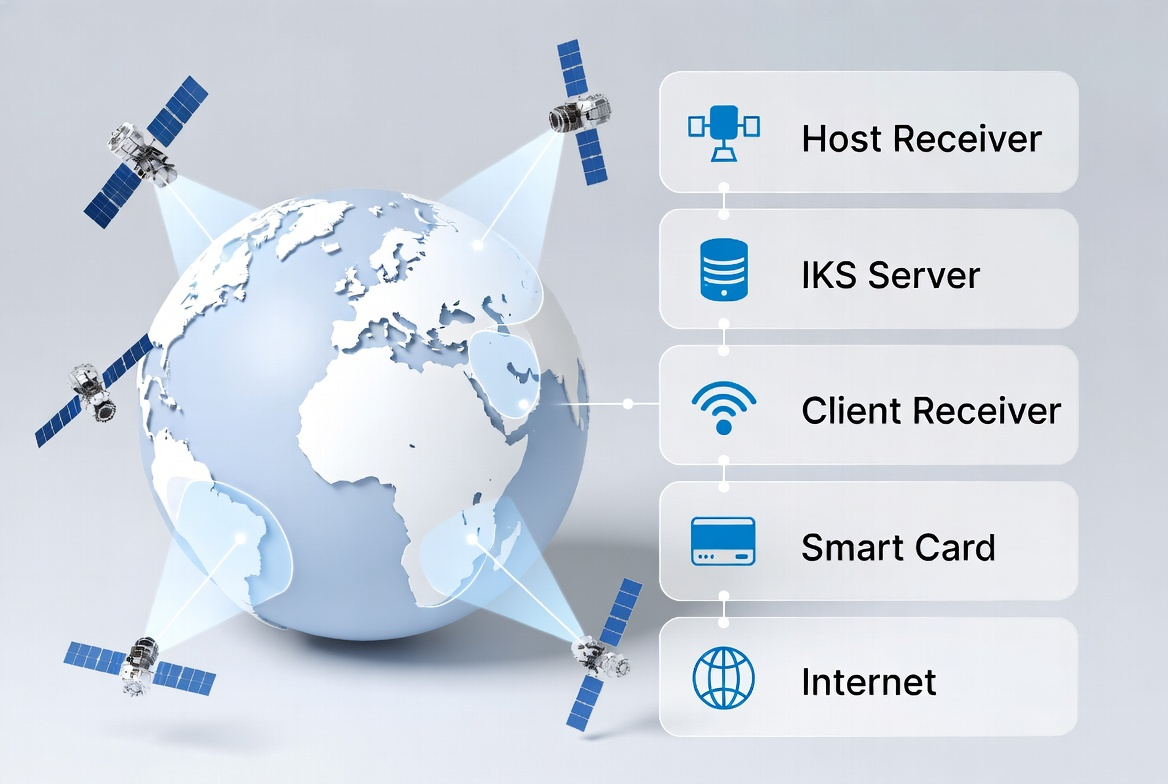
The next major leap was Internet Key Sharing (IKS).
Instead of local sharing, IKS servers used subscribed smart cards placed in data centers. These servers generated real-time control words and distributed them globally over the internet.
For users, it was simple:
- Buy an IKS subscription
- Enter server details in the receiver
- Enjoy premium channels for a fraction of the cost
IKS exploded between 2008 and 2015, especially for:
- Dish Network
- Sky UK
- Sports channels in pubs
Systems like CCCam, Newcamd, and modified Dreambox receivers dominated the scene.
Global Impact and Abuse
- UK pubs streamed Sky Sports illegally for £10/month
- The infamous BeoutQ operation pirated major sports leagues
- Entire regions relied on IKS instead of legal subscriptions
Providers fought back with:
- IP monitoring
- Key rotation
- Map switching
- Dealer arrests
By the late 2010s, IKS became unstable and risky.

5. 2020–2025: The Shift to IPTV and Streaming Piracy
By the 2020s, traditional satellite piracy was fading.
Modern encryption systems (Nagra 3 and Nagra 4) introduced:
- AES encryption
- Trusted Execution Environments (TEE)
- Self-destruct mechanisms
- AI-based anomaly detection
At the same time, consumer behavior changed. Viewers moved to OTT platforms, and pirates followed.
The New Piracy Model
- Illegal IPTV apps
- Thousands of channels via internet servers
- Restreamed premium sports and movies
- Malware-infected Android TV boxes
Governments responded aggressively:
- Italy’s Piracy Shield blocked streams in minutes
- ISPs forced to block servers
- AI watermarking traced illegal streams
By 2025, satellite-specific piracy is nearly obsolete, replaced by streaming-based threats worth billions in losses annually.

Conclusion: A War That Never Truly Ended
From rewiring smart cards on kitchen tables to running global IKS servers and IPTV farms, satellite TV piracy has continuously evolved with technology. Each security upgrade forced pirates to innovate, and each innovation triggered stronger defenses.
As of 2025, the battleground has shifted from satellites in orbit to servers, apps, and networks. While traditional satellite piracy is largely defeated, the broader fight against content piracy continues — now more complex, global, and digital than ever.
The story of satellite TV piracy is not just about stealing signals — it’s a mirror of how technology, economics, and human ingenuity collide in the digital age.