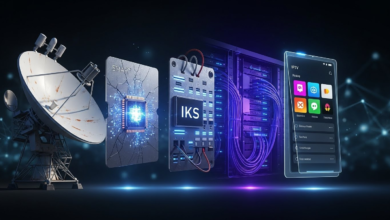
Internet Key Sharing (IKS), also known as card sharing or satellite key sharing (SKS), is a method that allows multiple receivers to access encrypted satellite TV channels using keys derived from a single legitimate smart card. While IKS can have legal applications in private home networks, it is widely used for illegal satellite TV piracy, resulting in substantial revenue loss for broadcasters like Dish Network, Bell TV, and DirecTV.
This article provides a comprehensive 2026 overview of IKS, including its history, technical mechanisms, legal implications, and modern trends.
Historical Background (Internet Key Sharing)
Origins (1990s)
IKS emerged from early research in European Scrambling Systems. In 1996, John McCormac described a method to share decryption keys from a single smart card, known as the “McCormac Hack.” Early implementations relied on local networks or physical card cloning, primarily targeting systems like DirecTV.
Evolution to IKS (2000s)
With internet connectivity, IKS shifted from hardware hacks to online distribution. Devices like nFusion receivers automated key retrieval from servers, enabling global access to satellite channels. Europe and South America saw high adoption due to cross-border satellite signals and licensing restrictions.
Key Milestones
| Year | Milestone |
|---|---|
| 2000s | Hacks on Dish Network & Bell ExpressVu using glitchers & emulators |
| 2010s | Free-to-Air (FTA) receivers modified for IKS (e.g., Pansat) |
| 2020s | Hybrid IKS/OTT streaming emerges; global crackdowns continue |
How IKS Works
IKS exploits the conditional access system (CAS) in satellite TV, including Nagra, Irdeto, and VideoGuard, by intercepting and redistributing short-lived decryption keys.
Core Mechanism
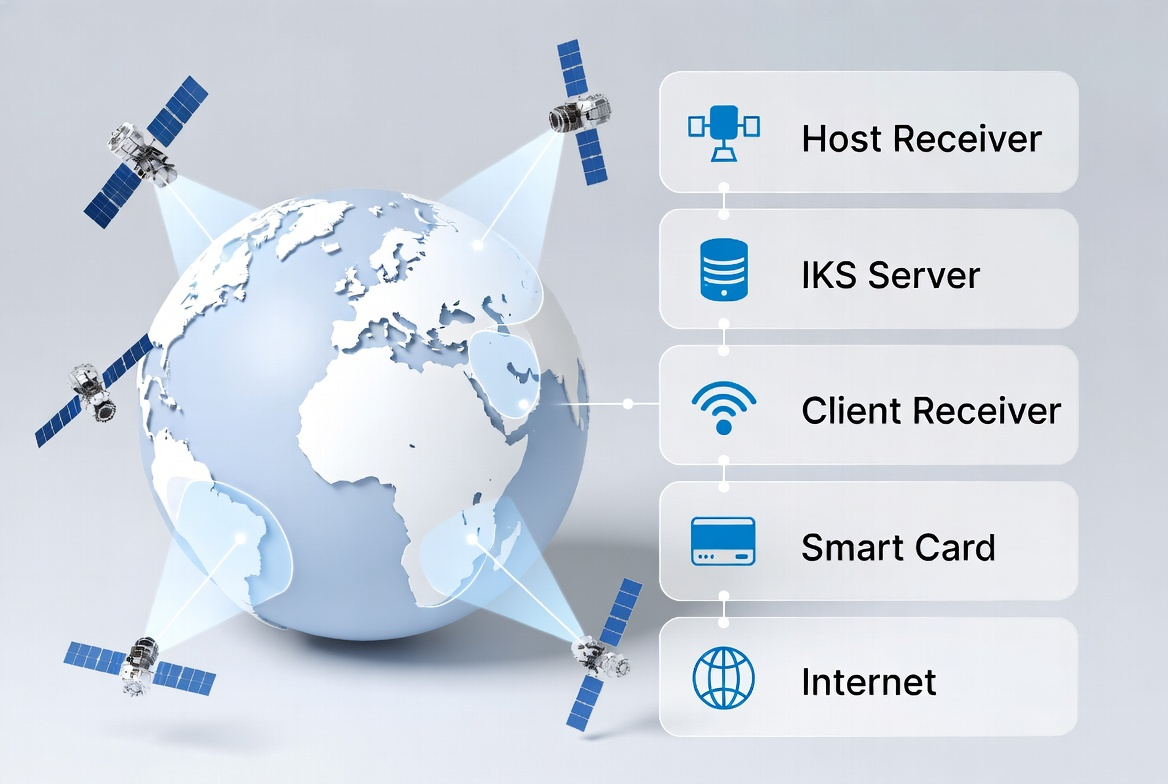
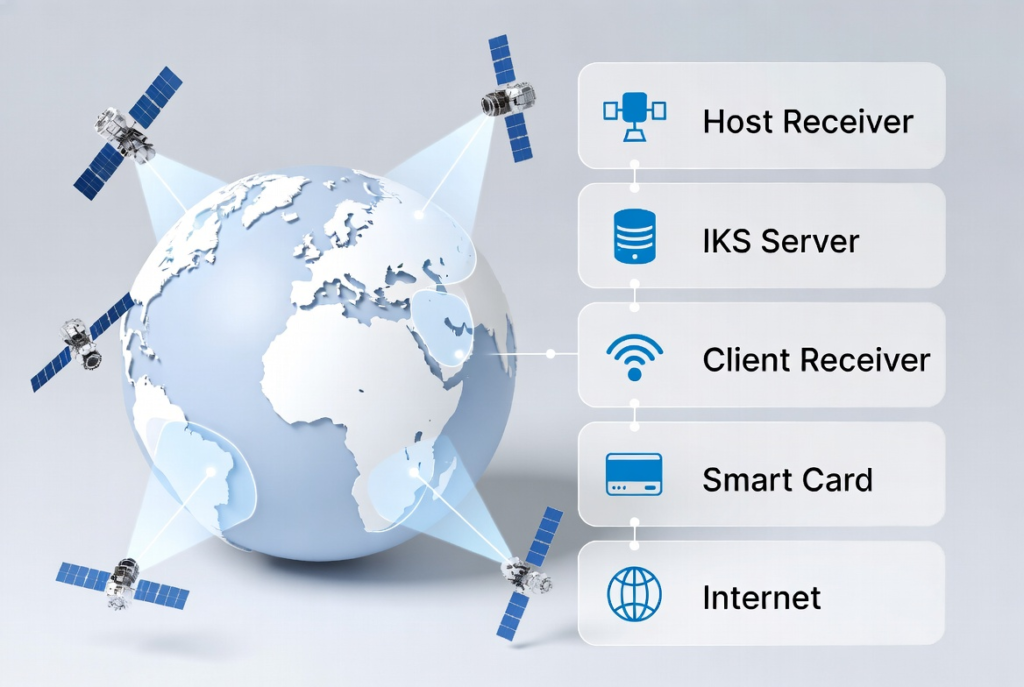
- A host receiver with a legitimate smart card receives an Entitlement Control Message (ECM) from the satellite.
- The smart card decrypts the ECM to obtain a 64-bit control word (CW).
- The host uploads the CW to an IKS server via the internet.
- Client receivers connect to the server and download the CW in real-time, descrambling the same channels.
Network Structure
- Users pay for server access ($10-50/month) or join sharing groups.
- Hybrid systems combine IKS with SKS for direct satellite-to-satellite key sharing.
Hardware Components
| Component | Function | Example |
|---|---|---|
| Smart Card | Decrypts ECM to CW | Nagra / VideoGuard cards (Dish Network) |
| Host Receiver | Extracts and uploads CW | Modified DVB-S2 set-top box |
| IKS Server | Distributes CW online | Private servers with passcodes |
| Client Receiver | Receives CW to descramble | Pansat or nFusion FTA boxes |
| Connection | Internet (Ethernet/Wi-Fi) | Real-time CW distribution |
Legality and Enforcement
Legal Status
IKS constitutes signal theft and circumvention of access control systems.
- USA: Violates DMCA, FCA, and ECPA; fines up to $500,000 or 5 years imprisonment.
- UK/EU: Prosecution under copyright laws; jail time documented in multiple cases.
Enforcement Actions
- Companies like NagraStar and Virgin Media raid sellers, issue demand letters ($5,000–$10,000), and pursue lawsuits.
- Efforts include shutting down Virtual Data Rooms in North Africa and monitoring IP addresses of users.
Risks for Users
- Traceable via IP.
- Risk of malware in pirated software.
- Service disruption by broadcasters countermeasures.
Prevention and Countermeasures
Broadcasters and CAS providers deploy multiple strategies to combat IKS:
- Technical Fixes: Encrypt CW; use algorithms like DVB-CSA3 (128-bit AES).
- Frequent CW Changes: Updates every 5–10 seconds overwhelm pirate networks.
- Card Pairing: Smart card tied to specific receiver serial number.
- Content Watermarking & ISP Cooperation: Track piracy sources and shut down servers.
Effectiveness: Traditional hacks decreased by 90–98%, but piracy persists through OTT streaming and illegal IPTV services.
Current Trends and Impact (2026)
- Gray Market: Cheap IKS receivers remain on e-commerce platforms, often disguised as standard FTA boxes.
- High-Piracy Regions: Middle East, Africa, Latin America with HD/4K receivers.
- Economic Losses: Dish Network estimates $1B+ annually lost to IKS.
- Future Outlook: Shift to illegal IPTV services for niche content like international sports or ethnic channels.
- Cybersecurity Focus: AI-driven detection and global cooperation to dismantle networks.
Conclusion
Internet Key Sharing highlights the ongoing cat-and-mouse game between satellite TV pirates and broadcasters. While it provides “free” access to channels, it comes with serious legal, cybersecurity, and ethical risks. Broadcasters continue to innovate with encryption and monitoring, but IKS evolves with technology, keeping the piracy challenge alive in 2026.