
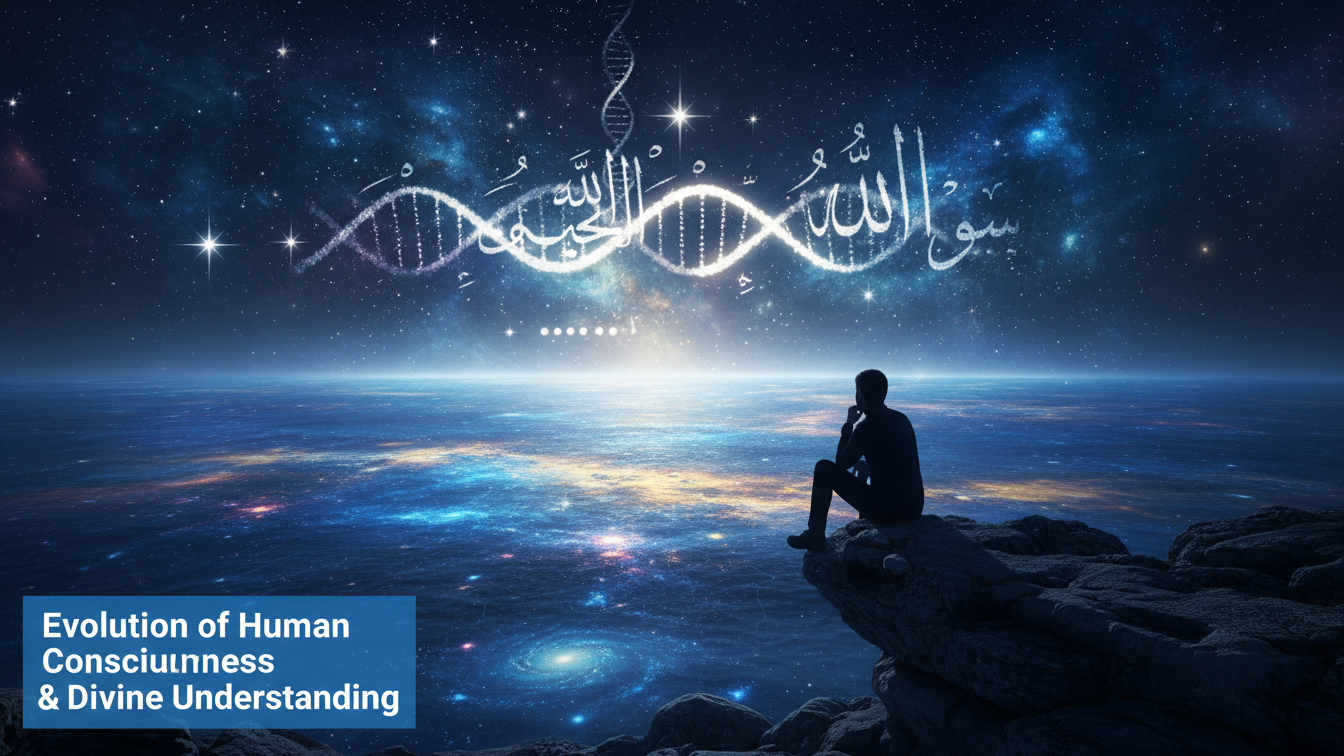
Evolution of Human Consciousness and Understanding of Divine Message
Humans have always been curious about the universe and its Creator. Questions like “Why did Allah create the universe in certain days?” or “Why does Allah’s description in the Qur’an use human-like imagery, such as a hand or a throne?” are common. The answers to these questions lie in the gradual development of human understanding, which we can call the “evolution of thought.” In Islam, Allah is beyond human comprehension, yet the Qur’an uses metaphors and symbolic language to help humans grasp divine realities in ways suited to their intellect and experience.
Prophets were sent as guides, showing humanity how to live ethically, understand the world, and grow spiritually. Just as a teacher adapts lessons to a student’s capacity, Allah reveals truths progressively, nurturing our reasoning, reflection (Tafakkur), and moral awareness. Through this process, humans can connect with Allah, understand the signs in creation, and develop both knowledge and faith, bridging the seen and unseen, the temporal and the eternal. Islam encourages believers to seek knowledge, ponder creation, and approach divine wisdom with humility, patience, and reverence for Allah’s infinite majesty.
Humanity’s Childhood and Gradual Guidance
Human civilization is like a growing child—learning slowly over time. Just as we don’t explain the complex physics of electricity to a small child, but instead warn them simply, ancient humans also had limited mental capacity.
Religions over history acted like steps to upgrade human consciousness. If complex truths were revealed too early, people wouldn’t have been able to understand them. God taught humans only what they could handle at their level of understanding.

Using Metaphors to Explain the Divine
When the Quran mentions God’s “throne,” “chair,” or “hand,” these are metaphors to help humans grasp non-physical truths. Human language is limited; we cannot fully describe God’s nature. Comparing His power to a “hand” or rule to a “throne” gives our minds a simple image of His greatness—like explaining a city’s technology to a child in a small village using familiar words.
Ocean of Knowledge and Human Limits
Even with today’s science and technology, humans still understand very little of the universe. We are just scratching the surface of matter, time, and life itself. Compared to all the knowledge in the cosmos, what we know is less than one percent.
Science and Human Understanding
The human mind’s journey isn’t just social but also biological and cosmic. Modern science actually supports some points:
- Inherited Knowledge and Epigenetics
Humans inherit not just physical traits but also the effects of environment and experiences. This explains why children from different societies think and learn differently. Over generations, accumulated knowledge allowed humans to understand complex truths, and God’s message gradually became clearer along with this mental evolution. - Creation “Days” and Time
Questions like “Why was the universe created in seven days?” reflect a misunderstanding of time. According to Einstein’s Theory of Relativity, time is not fixed—it changes with place and speed. The “days” mentioned in the Quran may refer to long periods, not literal 24-hour days. Just like a child learns slowly, the gradual creation of the universe teaches us that it works in order and law, not randomly. - Small Knowledge and Human Humility
Humanity knows less than one percent of the universe. Most of it remains a mystery as dark matter and dark energy. Humans are like someone standing in a small room, seeing the vast ocean outside but unable to measure its depth. God revealed knowledge only as much as humans could handle at their stage of understanding.
Conclusion
Humanity’s past was its childhood, and today is its adolescence. God guided humans like a patient teacher, gradually revealing truths according to their understanding. The metaphors in religious texts are not limitations—they are tools to bring humans closer to the reality of the universe. In Islam, the Qur’an emphasizes reflection (Tafakkur) and reasoning (Aql), inviting believers to ponder the signs of creation, the cycles of life, and the moral responsibilities entrusted to humanity.
Prophets served as guides, showing both practical and spiritual ways to navigate the complexities of life. Just as a teacher adapts lessons to a student’s readiness, God’s revelations were revealed progressively, helping humans evolve intellectually, morally, and spiritually. Understanding these truths requires patience, humility, and the willingness to see beyond literal interpretations, embracing the deeper harmony between divine guidance and the unfolding knowledge of the cosmos. In this light, Islam encourages a balance between faith and reason, urging humans to explore, question, and grow closer to God while recognizing their place in the vast universe.