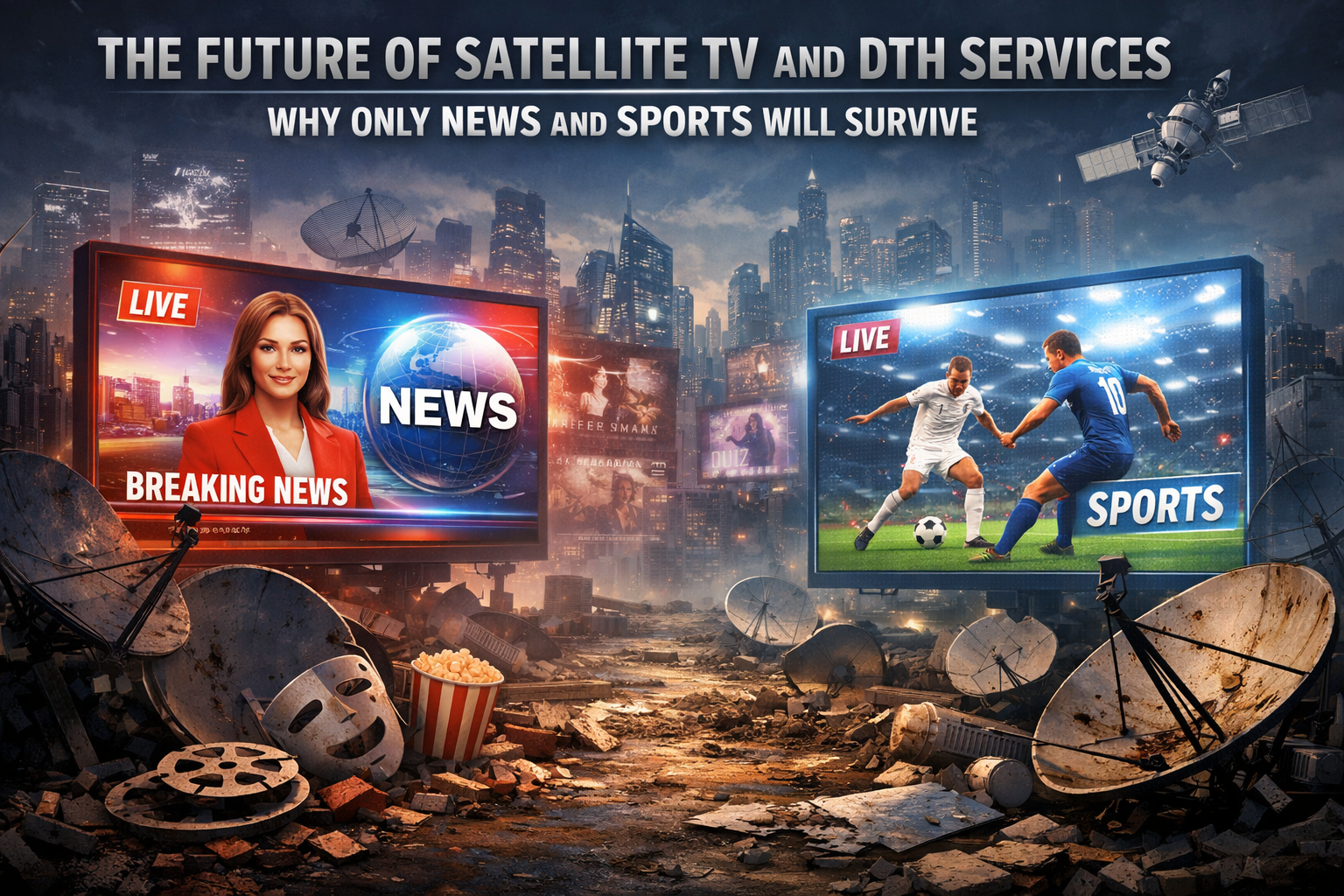
The global television industry is undergoing a massive transformation. Traditional satellite TV and Direct-to-Home (DTH) services are no longer the dominant force they once were. With the rapid rise of OTT (Over-the-Top) platforms like Netflix, YouTube, and Disney+, viewer behavior has shifted toward on-demand, personalized content.
However, satellite TV is not disappearing, it is evolving. The future of DTH lies in specialization, hybrid delivery models, and a focus on content that streaming cannot fully replace.
The Global Decline of Traditional Satellite TV
Across major markets like the United States and the United Kingdom, traditional pay-TV services (cable and satellite) are losing subscribers at a rapid pace.
- Linear TV viewership has dropped below 50% for the first time
- Streaming platforms now account for over 44% of total TV consumption
- Satellite providers are the most affected segment
For example, companies like DirecTV and Dish Network have experienced significant subscriber losses, forcing them to rethink their business models.
In the UK, Sky Group has already announced a transition away from satellite dishes, focusing instead on internet-based streaming services.
Why Entertainment Channels Are Moving to OTT
Entertainment content, such as movies, TV shows, and series, is rapidly migrating to OTT platforms. The reasons are clear:
1. On-Demand Viewing
Viewers prefer watching content anytime, rather than following fixed schedules.
2. Binge-Watching Culture
Streaming platforms encourage continuous viewing, which satellite TV cannot replicate effectively.
3. Lower Cost & Flexibility
OTT subscriptions are often cheaper and allow users to choose what they want to watch.
4. Platform Control
Broadcasters are launching their own apps like SonyLIV and JioCinema to retain control over content distribution.
As a result, entertainment channels are gradually becoming less relevant on satellite platforms.
Why News and Sports Channels Will Survive
While entertainment content is shifting to OTT, news and sports channels remain strong on satellite TV. This is not accidental, it is based on the unique strengths of satellite broadcasting.
1. Live Content Advantage
Sports events and breaking news require real-time broadcasting. Satellite TV provides:
- Minimal latency
- Reliable live coverage
- No buffering issues
This makes it ideal for live events like cricket matches, football games, and elections.
2. One-to-Many Broadcasting Efficiency
Satellite transmission allows a single signal to reach millions of viewers simultaneously at a very low cost, something OTT struggles with during high-traffic live events.
3. Rural and Low-Internet Areas
In regions with limited or unstable internet, satellite TV remains the most reliable option. This is especially true in countries like Pakistan and India.
4. Mass Reach for National Events
Governments and broadcasters rely on satellite TV for nationwide coverage of important events, making it indispensable.
The Rise of Hybrid TV Models
The future is not satellite vs OTT, it is satellite + OTT integration.
Major providers are already shifting toward hybrid models:
- DirecTV and Dish Network are offering smaller “genre-based” packages (sports, news, etc.)
- Streaming apps are integrating live sports (e.g., WWE on Netflix, NFL on Peacock)
- Set-top boxes are evolving to support both satellite signals and internet streaming
This hybrid approach allows users to:
- Watch live TV via satellite
- Access on-demand content via internet
- Customize channel packages
Pakistan and India: A Unique Market Scenario
Pakistan
Satellite DTH services never fully matured due to cable dominance and regulatory challenges. However:
- Free-to-air satellite dishes remain popular in rural areas
- Many channels are broadcast via satellites like Paksat and Apstar
- OTT adoption is rising rapidly among younger audiences
The upcoming launch of satellite internet projects like Amazon Project Kuiper could transform the market by enabling hybrid TV and high-speed connectivity.
India
India presents a mixed scenario:
- DTH providers like Tata Play and Dish TV are facing financial pressure
- However, free satellite platforms like DD Free Dish are thriving in rural regions
- Hybrid DTH + OTT bundles are becoming the future standard
Technological Innovations Shaping the Future
The next phase of satellite TV will be driven by advanced technologies:
1. LEO Satellites
Low Earth Orbit systems (similar to Starlink) will enable:
- Faster internet
- Direct-to-device broadcasting
- Seamless hybrid TV experiences
2. AI-Powered Personalization
Satellite platforms may integrate AI to recommend content, similar to OTT platforms.
3. 4K and 8K Broadcasting
Satellite remains the most efficient way to deliver ultra-high-definition content at scale.
Market Outlook (2026–2033)
- Western markets: Expected annual decline of up to 8% in traditional satellite TV
- Asia-Pacific: Continued growth driven by rural demand
- Global DTH market: Projected CAGR between 5% and 13% (hybrid-driven growth)
The key trend is clear: video consumption is increasing, but delivery methods are changing.
Conclusion
Satellite TV is not dying, it is transforming.
Entertainment content is moving toward OTT platforms, leaving satellite TV to focus on its core strengths: live broadcasting and mass accessibility. As a result, news and sports channels will remain dominant in the DTH ecosystem.
The future lies in hybrid systems that combine satellite reliability with OTT flexibility. Over the next decade, consumers can expect a unified experience where satellite, internet, and streaming platforms work together seamlessly.
In this evolving landscape, satellite TV will continue to play a crucial role, but in a more focused and technologically advanced form.