

Bing Search Bug Exposed: Why Advanced Search Operators Are Failing in 2025
Inconsistent Bing dork results raise serious concerns about search reliability
Search engines are expected to be consistent, predictable, and accurate—especially when users rely on advanced search operators like site: to filter precise information. However, recent observations strongly suggest that Bing Search Engine is currently failing at this fundamental task.
Multiple tests using the exact same query — site:bbc.com — produced wildly different and completely irrelevant results on every attempt. This behavior is not only confusing but also damaging for researchers, journalists, SEO professionals, and cybersecurity analysts who depend on reliable search logic.
This article breaks down the issue using real-world evidence, explains why it matters, and explores what could be going wrong inside Bing’s search system.
What Is the site: Operator and Why It Matters
The site: operator is one of the most basic and widely used advanced search commands. Its function is simple:
Show results only from a specific domain.
For example:site:bbc.com should return only BBC-related pages, such as news articles, videos, or reports hosted on bbc.com.
This operator is commonly used for:
- SEO audits
- Academic research
- Journalism and fact-checking
- Cybersecurity investigations
- Website indexing verification
When it stops working, trust in the search engine collapses.
Screenshot Evidence: Same Query, Completely Different Results
The issue becomes undeniable when analyzing three separate Bing searches made with the same query, differing only by Bing’s internal session parameter (cvid).
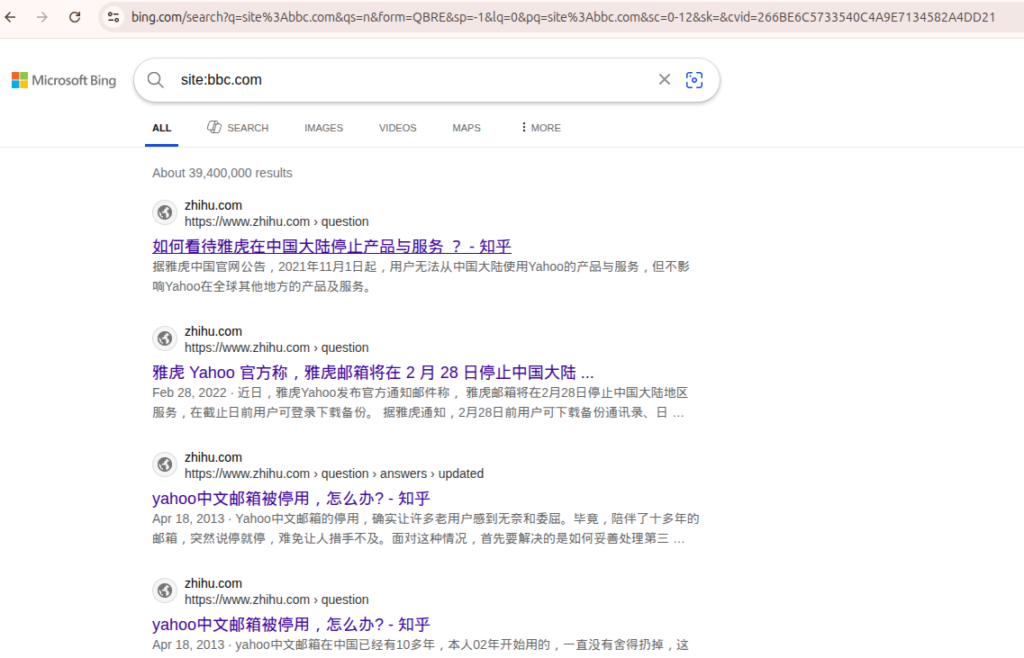
🔍 Screenshot 1: Chinese Q&A Results Instead of BBC
Query: site:bbc.com
Claimed Results: ~39,400,000
What Appeared:
- Results exclusively from zhihu.com
- Content written in Chinese
- Topics about Yahoo services shutting down in China
- Zero BBC links
📌 Observation:
Bing completely ignored the domain restriction and treated the query as a generic keyword search.
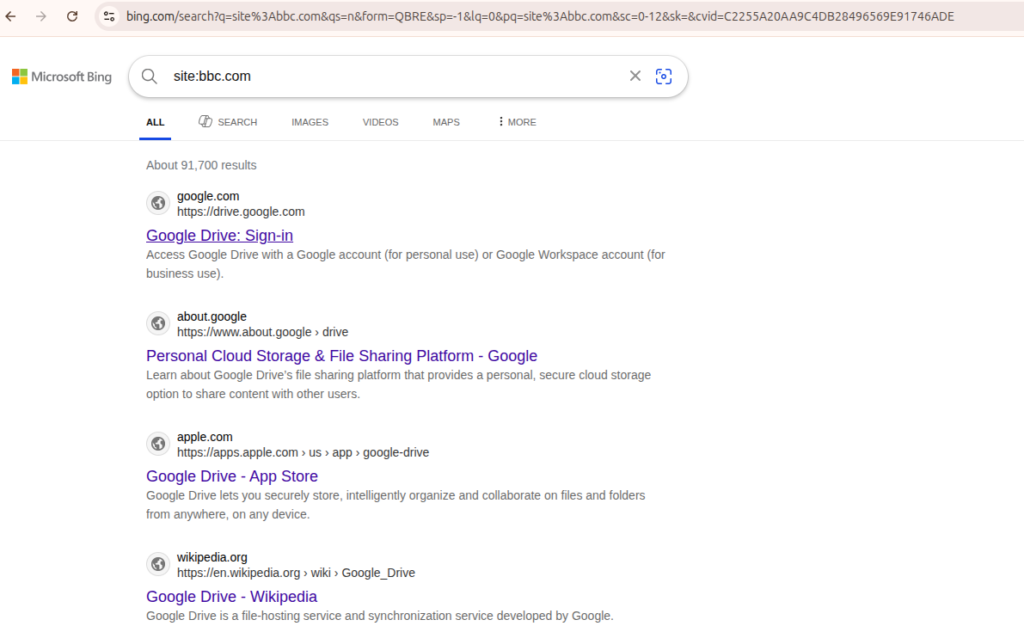
🔍 Screenshot 2: Google Drive Pages Dominate Results
Claimed Results: ~91,700
Top Domains Shown:
- google.com
- about.google
- apple.com
- wikipedia.org
Main Topic: Google Drive and cloud storage services
📌 Observation:
Not a single result from bbc.com.
The topic shifted entirely, proving randomization rather than relevance.
🔍 Screenshot 3: Quote Website Takes Over
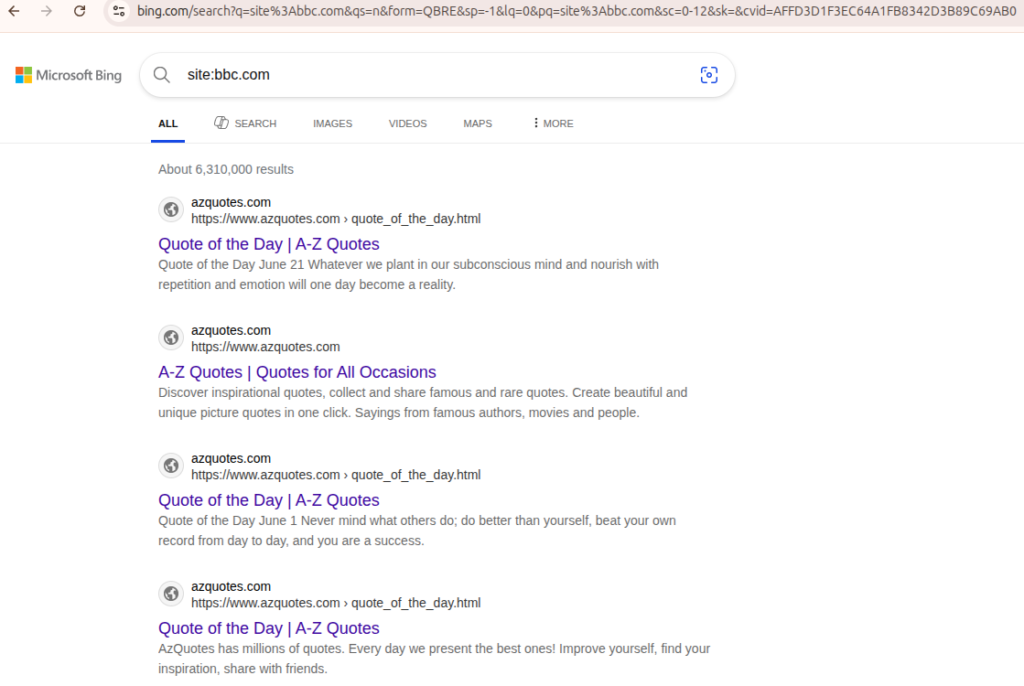
Claimed Results: ~6,310,000
Top Results:
- azquotes.com only
- “Quote of the Day” pages
- Inspirational quotes unrelated to news or BBC
📌 Observation:
This third variation removes any doubt. The same query now leads to a quotes database, which has no logical connection to BBC or the search operator.

Key Patterns Identified
From the screenshots and repeated tests, several alarming patterns emerge:
1. Bing Is Ignoring Advanced Operators
The site: operator is completely bypassed in all cases. This aligns with growing reports that Bing’s advanced operators (filetype:, inurl:) are unreliable in 2025.
2. Severe Result Randomization
Each refresh returns results from a new, unrelated domain:
- Zhihu → Google → AZQuotes
This behavior does not match personalization or location-based filtering.
3. Massive Result Count Fluctuations
Estimated results jump unpredictably:
- 39 million → 91 thousand → 6 million
Such swings indicate backend instability or fallback logic.
4. Session Parameter Confirms Bing-Side Issue
The only URL difference is the cvid (session ID).
This confirms the bug is not user error.
Possible Reasons Behind This Bing Search Bug
🛠️ 1. Operator Handling Bug
Bing’s query parser may be failing to correctly interpret advanced operators after recent algorithm updates.
🔀 2. Anti-Dork Randomization
To prevent scraping or misuse, Bing may intentionally dilute operator-based queries. However, this should not fully ignore the operator.
📉 3. Indexing or Crawling Failure
If Bing’s index of bbc.com is incomplete or unstable, the engine may fall back to generic results rather than returning zero matches.
🧪 4. Algorithmic Testing Gone Wrong
A/B testing or relevance experiments may be introducing excessive noise into results.
Why This Issue Is Serious
This is not a cosmetic bug—it affects core search reliability.
Impacted users include:
- SEO professionals verifying indexed pages
- Journalists researching trusted sources
- Academics conducting domain-based studies
- Security researchers using search dorks
When a search engine cannot honor its own operators, its credibility is at risk.
What Users Can Do Right Now
✅ Test Across Environments
- Incognito mode
- Different browsers
- Different regions
🔄 Use Alternatives
- Google Search (more reliable for dorks)
- DuckDuckGo (with caution, as it relies on Bing)
📣 Report the Issue
- Submit feedback via Bing Help
- Tag @bing and @Microsoft on X
- Share reproducible examples publicly
Final Verdict
Based on repeated evidence and detailed analysis, the conclusion is clear:
Bing’s advanced search operator handling is broken in 2025.
Until Microsoft addresses this issue transparently, Bing cannot be considered a reliable tool for domain-restricted or research-grade searches.
Public reporting and continued testing are essential to push for a fix.